
Online Database of Chemicals from Around the World
| Xi'an Reapsource Biotechnology Co., Ltd. | China | |||
|---|---|---|---|---|
 | www.rpybiotech.com | |||
 | +86 18991103357 | |||
 | buyun.ping@rpybiotech.com | |||
 | QQ Chat | |||
 | WeChat: 18991103357 | |||
| Chemical manufacturer since 2024 | ||||
| chemBlink Standard supplier since 2026 | ||||
| Classification | Chemical reagent >> Deuterated reagent |
|---|---|
| Name | 4'-Bromo-1,1'-biphenyl-2,2',3,3',4,5,5',6,6'-d9 |
| Synonyms | 1-bromo-2,3,5,6-tetradeuterio-4-(2,3,4,5,6-pentadeuteriophenyl)benzene |
| Molecular Structure | 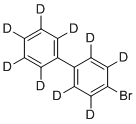 |
| Molecular Formula | C12BrD9 |
| Molecular Weight | 242.16 |
| CAS Registry Number | 142475-00-1 |
| SMILES | [2H]C1=C(C(=C(C(=C1[2H])[2H])C2=C(C(=C(C(=C2[2H])[2H])Br)[2H])[2H])[2H])[2H] |
| Density | 1.4±0.1 g/cm3 Calc.* |
|---|---|
| Boiling point | 309.8±11.0 °C 760 mmHg (Calc.)* |
| Flash point | 141.8±13.7 °C (Calc.)* |
| Index of refraction | 1.601 (Calc.)* |
| * | Calculated using Advanced Chemistry Development (ACD/Labs) Software. |
| Hazard Symbols |  GHS07 Warning Details GHS07 Warning Details |
|---|---|
| Risk Statements | H302-H315-H319-H350 Details |
| Safety Statements | P280-P305+P351+P338 Details |
| SDS | Available |
 chemBlink Chemical Story
|
4′-Bromo-1,1′-biphenyl-2,2′,3,3′,4,5,5′,6,6′-d9 is a deuterium-labeled and halogen-substituted biphenyl derivative in which nine hydrogen atoms on the biphenyl framework are replaced by deuterium atoms, and a bromine atom is introduced at the 4′ position of the second phenyl ring. The compound belongs to the broader class of isotopically labeled aromatic hydrocarbons that are widely used in analytical chemistry, mechanistic studies, and mass spectrometric quantification. Biphenyl is a fundamental aromatic hydrocarbon composed of two benzene rings linked by a single carbon–carbon bond. Its chemistry has been extensively studied since the early development of aromatic theory in organic chemistry, as it represents a simple system for investigating conjugation, rotational barriers, and substitution patterns in aryl–aryl linked compounds. Substituted biphenyl derivatives, including halogenated and isotopically labeled analogues, are commonly used as reference compounds and synthetic intermediates. In 4′-bromo-1,1′-biphenyl-2,2′,3,3′,4,5,5′,6,6′-d9, deuterium substitution replaces aromatic hydrogen atoms across both phenyl rings in a defined isotopic pattern. Deuterium is a stable isotope of hydrogen with one proton and one neutron, and its incorporation into organic molecules produces isotopologues that are chemically similar but can be distinguished by mass spectrometry and, in some cases, by nuclear magnetic resonance spectroscopy. Such isotopic labeling is widely used to track molecular behavior, quantify compounds in complex mixtures, and serve as internal standards in analytical workflows. The presence of a bromine substituent at the 4′ position introduces a halogen functionality that significantly affects the compound’s electronic and physicochemical properties. Bromine is an electron-withdrawing substituent through inductive effects and also participates in characteristic isotopic patterns in mass spectrometry due to the natural abundance of bromine isotopes. Aryl bromides are commonly used in organic synthesis as intermediates for cross-coupling reactions, such as Suzuki, Heck, and Sonogashira reactions, which enable carbon–carbon bond formation in the construction of more complex aromatic systems. The combination of deuterium labeling and halogen substitution makes this compound particularly useful in analytical and mechanistic chemistry. Deuterated biphenyl derivatives are frequently employed as internal standards in gas chromatography–mass spectrometry (GC-MS) and liquid chromatography–mass spectrometry (LC-MS) because they closely mimic the chemical behavior of their non-deuterated counterparts while being distinguishable by mass difference. This allows for accurate quantification by correcting for sample loss, ionization variability, and instrumental fluctuations. From a structural standpoint, biphenyl systems exhibit restricted rotation around the central carbon–carbon bond due to steric interactions between ortho hydrogen atoms. In substituted biphenyls, including deuterated analogues, this rotational barrier can influence conformational distributions and affect spectroscopic properties. Although deuterium substitution does not significantly alter bond lengths or electronic structure, it can lead to measurable isotope effects in vibrational frequencies and reaction kinetics. The selective placement of deuterium atoms at multiple positions on the aromatic rings indicates a fully or partially deuterated isotopologue designed for uniform isotopic enrichment. Such labeling strategies are typically achieved through catalytic hydrogen–deuterium exchange reactions or through synthesis from deuterated starting materials. These methods are well established in isotopic chemistry and are used to produce compounds for both research and industrial applications. Physicochemically, the compound is expected to behave similarly to non-deuterated bromobiphenyl derivatives, with low polarity and high hydrophobicity due to its aromatic hydrocarbon framework. The presence of bromine increases molecular weight and polarizability, while deuterium substitution has minimal impact on bulk solubility but can slightly influence vibrational and thermodynamic properties. In analytical applications, compounds of this type are particularly important in quantitative mass spectrometry, where isotopically labeled standards are used to improve measurement accuracy. The nearly identical chemical behavior of deuterated and non-deuterated species allows for reliable calibration while the mass difference enables clear spectral separation. This principle is widely used in environmental analysis, pharmaceutical quantification, and metabolic studies. Overall, 4′-bromo-1,1′-biphenyl-2,2′,3,3′,4,5,5′,6,6′-d9 is a deuterium-enriched brominated biphenyl derivative designed primarily for analytical and synthetic applications. Its significance lies in the combination of isotopic labeling and halogen functionality, enabling its use as a tracer, internal standard, and synthetic intermediate in advanced chemical and analytical methodologies. |
| Market Analysis Reports |