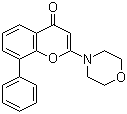
A widely used research compound can become important both for what it revealed and for the limitations it taught scientists to recognize. LY294002, CAS 154447-36-6, is such a compound. It became a familiar experimental inhibitor of phosphoinositide 3-kinase, usually abbreviated PI3K, while later work showed why its effects should not be treated as proof that PI3K alone caused every observed response.
PI3Ks participate in cellular signaling by modifying phosphoinositide lipids. Their products help organize signaling events rather than serving only as passive membrane components. An inhibitor can provide a way to perturb this network and ask which downstream events change. The experimental attraction is the ability to intervene chemically, but the interpretation depends on knowing what else the compound affects.
Vlahos and colleagues reported LY294002 in 1994 during work on inhibitors related to quercetin and other chromone structures. The study established inhibition in the assays and comparisons then examined, helping provide an accessible chemical tool for investigation of PI3K function. The historical description of specificity belongs to that experimental setting; it should not be read as a permanent guarantee against every target subsequently investigated.
Structural research added another kind of evidence. In 2000, Walker and colleagues reported crystallographic studies of PI3K bound to several inhibitors, including LY294002. The structures located these compounds in the ATP-binding pocket and showed that related inhibitors could adopt different orientations. A binding structure helps explain molecular recognition, although a structure with one protein does not by itself establish selectivity across all other proteins.
That broader question became especially clear in a 2007 study by Gharbi and colleagues. Using an immobilized analogue in a chemical-proteomic strategy, they investigated proteins captured from cellular extracts. The work identified interactions extending beyond class I PI3Ks. It demonstrated why a compound's established target and its full interaction profile are not necessarily the same thing.
Binding and inhibition also need to be distinguished. Capture on an affinity matrix can identify a potential interaction, while an enzyme assay asks whether a particular activity changes under specified conditions. A response in an intact cell adds further factors, including compound access and the surrounding signaling network. These measurements complement one another, but none automatically substitutes for all the others.
The practical lesson is to connect a cellular observation with independent evidence. A change after exposure to LY294002 is initially a compound-associated result. Assigning that change to a specific target is a further inference, strengthened by appropriately chosen genetic or chemical comparisons and direct pathway measurements. A familiar inhibitor label does not remove the need for that reasoning.
Assay conditions are part of that evidence as well. An inhibition measurement is obtained with a particular enzyme preparation, substrate environment, and observation period. A cellular experiment adds exposure time and the biological state of the cells. Comparing results therefore requires more than matching the inhibitor name. The question is whether the measurements address the same molecular activity and whether the experimental conditions support the proposed comparison, rather than assuming one reported potency is an immutable property in every setting.
LY294002 is therefore best understood as a historically influential experimental reagent with known selectivity limitations, rather than as an exclusive switch for one pathway or evidence of a clinical treatment. Its story links inhibitor discovery, structural biology, and chemical proteomics. The value is not diminished by recognizing its boundaries; those boundaries help researchers distinguish a useful perturbation from a conclusion that requires additional support.
References:
1. Vlahos CJ et al. A specific inhibitor of phosphatidylinositol 3-kinase, 2-(4-morpholinyl)-8-phenyl-4H-1-benzopyran-4-one (LY294002). J Biol Chem. 1994;269:5241-5248. https://pubmed.ncbi.nlm.nih.gov/8106507/
2. Walker EH et al. Structural determinants of phosphoinositide 3-kinase inhibition by wortmannin, LY294002, quercetin, myricetin, and staurosporine. Mol Cell. 2000;6:909-919. https://doi.org/10.1016/S1097-2765(05)00089-4
3. Gharbi SI et al. Exploring the specificity of the PI3K family inhibitor LY294002. Biochem J. 2007;404:15-21. https://doi.org/10.1042/BJ20061489
|





 GHS07 Warning Details
 chemBlink Chemical Story