
Online Database of Chemicals from Around the World
| Shanghai Sinofluoro chemicals Co., Ltd. | China | |||
|---|---|---|---|---|
 | www.sinofluoro.com | |||
 | +86 (21) 6427-9360 | |||
 | +86 (21) 6427-8603 | |||
 | simon.lv@sinofluoro.com jerry.chen@sinofluoro.com | |||
 | QQ Chat | |||
| Chemical manufacturer since 2008 | ||||
| chemBlink Standard supplier since 2008 | ||||
| Simagchem Corporation | China | |||
|---|---|---|---|---|
| www.simagchem.com | |||
| +86 13806087780 | |||
| +86 (592) 268-0237 | |||
| sale@simagchem.com | |||
| Chemical manufacturer since 2002 | ||||
| chemBlink Standard supplier since 2008 | ||||
| Wilshire Technologies, Inc. | USA | |||
|---|---|---|---|---|
| www.wilshiretechnologies.com | |||
| +1 (609) 683-1117 | |||
| +1 (732) 274-0049 | |||
| Wilshire-info@evonik.com | |||
| Chemical manufacturer since 1997 | ||||
| chemBlink Standard supplier since 2010 | ||||
| Neostar United (Changzhou) Industrial Co., Ltd. | China | |||
|---|---|---|---|---|
| www.neostarunited.com | |||
| +86 (519) 8555-7386 +86 18015025600 | |||
| +86 (519) 8555-7389 | |||
| marketing1@neostarunited.com | |||
| Chemical distributor since 2014 | ||||
| chemBlink Standard supplier since 2020 | ||||
| wuhan chemi Pharmacy Chemical Technology Co., Ltd. | China | |||
|---|---|---|---|---|
| www.chemipharm.com.cn | |||
| +86 13971619949 | |||
| gmn424@chemipharm.com.cn | |||
| QQ Chat | |||
 | WeChat: 13971619949 | |||
| Chemical manufacturer since 2014 | ||||
| chemBlink Standard supplier since 2026 | ||||
| Ricci Chimica | Italy | |||
|---|---|---|---|---|
| www.riccichimica.com | |||
| +39 (75) 692-9241 | |||
| +39 (75) 592-6595 | |||
| info@riccichimica.com | |||
| Chemical manufacturer | ||||
| Classification | Pharmaceutical intermediate >> Heterocyclic compound intermediate >> Pyrimidine compound >> Methyl pyrimidine |
|---|---|
| Name | 4-Hydroxy-2-(trifluoromethyl)pyrimidine |
| Synonyms | 2-(Trifluoromethyl)pyrimidin-4-ol; 2-Trifluoromethyl-4(1H)-pyrimidinone |
| Molecular Structure | 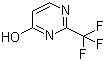 |
| Molecular Formula | C5H3F3N2O |
| Molecular Weight | 164.08 |
| CAS Registry Number | 1546-80-1 |
| EC Number | 671-817-3 |
| SMILES | C1=CN=C(NC1=O)C(F)(F)F |
| Density | 1.5±0.1 g/cm3 Calc.* |
|---|---|
| Melting point | 168 - 171 °C (Expl.) |
| Boiling point | 140.9±40.0 °C 760 mmHg (Calc.)* |
| Flash point | 39.0±27.3 °C (Calc.)* |
| Index of refraction | 1.456 (Calc.)* |
| * | Calculated using Advanced Chemistry Development (ACD/Labs) Software. |
| Hazard Symbols |  GHS07 Warning Details GHS07 Warning Details | ||||||||||||||||||||||||||||
|---|---|---|---|---|---|---|---|---|---|---|---|---|---|---|---|---|---|---|---|---|---|---|---|---|---|---|---|---|---|
| Risk Statements | H302+H312+H332-H302-H312-H315-H319-H332-H335 Details | ||||||||||||||||||||||||||||
| Safety Statements | P261-P264-P264+P265-P270-P271-P280-P301+P317-P302+P352-P304+P340-P305+P351+P338-P317-P319-P321-P330-P332+P317-P337+P317-P362+P364-P403+P233-P405-P501 Details | ||||||||||||||||||||||||||||
| Hazard Classification | |||||||||||||||||||||||||||||
| |||||||||||||||||||||||||||||
| SDS | Available | ||||||||||||||||||||||||||||
 chemBlink Chemical Story
|
4-Hydroxy-2-(trifluoromethyl)pyrimidine is a substituted pyrimidine derivative containing a hydroxyl group at the 4-position and a strongly electron-withdrawing trifluoromethyl group at the 2-position. Pyrimidine is a six-membered aromatic heterocycle with two nitrogen atoms at positions 1 and 3, and it forms the core structure of several biologically important nucleobases such as cytosine, thymine, and uracil. Substitution on this ring system significantly modifies its electronic distribution, tautomeric behavior, and chemical reactivity. The chemistry of hydroxylated pyrimidines has long been studied in the context of nucleic acid chemistry and heterocyclic synthesis. Pyrimidin-4-ol-type structures can exist in tautomeric equilibrium with their corresponding carbonyl (lactam) forms, depending on solvent conditions and substitution patterns. This tautomerism is an important feature of many nitrogen-containing heterocycles and influences hydrogen-bonding behavior as well as spectroscopic properties. In 4-hydroxy-2-(trifluoromethyl)pyrimidine, the hydroxyl group at the 4-position is directly conjugated with the aromatic heterocycle, allowing resonance stabilization of the anionic form under basic conditions. This enhances the acidity of the hydroxyl proton relative to simple alcohols. In many substituted pyrimidin-4-ols, the equilibrium between the enol-like (hydroxy) form and the corresponding keto (pyrimidinone) form is influenced by both electronic and steric effects of ring substituents. The trifluoromethyl group at the 2-position is a strongly electron-withdrawing substituent due to the high electronegativity of fluorine atoms. It exerts a powerful inductive effect that decreases electron density on the pyrimidine ring. This influences both the acidity of the hydroxyl group and the overall reactivity of the heterocycle. The CF₃ group is also known to increase lipophilicity and metabolic stability in many heteroaromatic systems, making such motifs common in medicinal and agrochemical chemistry. Pyrimidine derivatives containing both hydroxyl and trifluoromethyl substituents are of interest as intermediates in organic synthesis. The hydroxyl group can serve as a site for further derivatization, such as etherification or esterification, while also participating in hydrogen bonding interactions. In synthetic heterocyclic chemistry, such compounds may also undergo substitution or rearrangement reactions depending on reaction conditions and activation strategies. The presence of two ring nitrogen atoms in pyrimidine significantly influences its electronic structure. These nitrogen atoms withdraw electron density from the ring via inductive effects and alter the distribution of π-electrons, making the system more electron-deficient than benzene. As a result, substituted pyrimidines often display reactivity patterns distinct from simple aromatic hydrocarbons, particularly in nucleophilic aromatic substitution and proton-transfer equilibria. From a physicochemical standpoint, 4-hydroxy-2-(trifluoromethyl)pyrimidine is expected to exhibit moderate polarity due to the combination of a heteroaromatic ring, a polar hydroxyl group, and a strongly electron-withdrawing CF₃ substituent. The compound is likely capable of both hydrogen-bond donation and acceptance, which influences its solubility in polar solvents and its solid-state packing behavior. Compounds of this general structural class are commonly used as building blocks in heterocyclic synthesis, where functionalized pyrimidines serve as precursors to more complex nitrogen-containing molecules. The CF₃ group is particularly valuable in tuning the electronic properties of downstream derivatives, while hydroxyl substitution provides a handle for further chemical modification. Overall, 4-hydroxy-2-(trifluoromethyl)pyrimidine is an electron-deficient, functionalized pyrimidine derivative featuring a tautomerically active hydroxyl group and a strongly deactivating trifluoromethyl substituent. Its significance lies in its role as a reactive heterocyclic intermediate and in its contribution to understanding substituent effects in nitrogen-rich aromatic systems. References 2011. Reaction of α-Formyl Esters or Equivalents with Amidine Derivatives. Science of Synthesis. URL: https://science-of-synthesis.thieme.com/app/text/?id=SD-246-00105 |
| Market Analysis Reports |