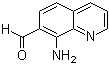
8-Aminoquinoline-7-carbaldehyde, CAS 158753-17-4, is a compact bifunctional heteroaromatic building block. PubChem confirms the formula C10H8N2O and the structure of a quinoline ring bearing neighboring amino and aldehyde groups. Public literature devoted specifically to this CAS number is limited, so its most reliable chemical story is based on those documented functional groups rather than an unsupported claim for a particular commercial end product.
The quinoline nucleus contributes a rigid fused aromatic system containing a ring nitrogen. Quinoline derivatives are widely used as scaffolds in medicinal chemistry, coordination chemistry and functional materials because substitution around the fused ring can precisely alter electronic and steric properties. In this compound, an amino group at position 8 and a formyl group at position 7 sit next to one another, creating an especially useful arrangement for further molecular construction.
The aldehyde can undergo familiar carbonyl reactions such as condensation with amines, formation of imines, reduction to an alcohol, oxidation to a carboxylic acid, or carbon-carbon bond-forming transformations. The adjacent amino group can participate in acylation, diazotization and heterocycle-forming chemistry. Because both functions occur on the same rigid aromatic framework, reactions can be designed to preserve one group while transforming the other, or to use both groups in ring closure.
The 8-aminoquinoline motif is also notable for metal coordination: the ring nitrogen and amino functionality can cooperate in binding metal ions when geometry permits. Adding an adjacent aldehyde introduces another handle for ligand elaboration. That does not establish a specific application for CAS 158753-17-4, but it explains why such a molecule is attractive as a research intermediate.
This compound therefore represents a recurring idea in fine-chemical synthesis: value can come from placing two orthogonal reactive groups at precisely chosen positions on a stable scaffold. The product is not necessarily important because it is used directly; it may be important because it shortens the route to many more elaborate molecules.
References:
1. PubChem, 8-Aminoquinoline-7-carboxaldehyde, CID 11052098, CAS 158753-17-4.
2. CAS Common Chemistry, CAS 158753-17-4.
3. Joule JA, Mills K. Heterocyclic Chemistry. 5th ed. Wiley, 2010.
|





 GHS07 Warning Details
 chemBlink Chemical Story