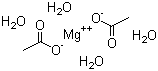
Magnesium acetate tetrahydrate, CAS 16674-78-5, is the hydrated magnesium salt of acetic acid, with the formula Mg(CH3COO)2·4H2O and a molecular weight of approximately 214.45. It is a water-soluble magnesium salt commonly encountered as a laboratory reagent and as a convenient precursor for preparing other magnesium-containing materials. Its formula also illustrates an important feature of crystalline solids: the four water molecules are not simply moisture clinging to the crystals. They belong to the structure of the hydrate itself.
Water plays several very different roles in chemistry. It can be a solvent surrounding a dissolved substance, liquid trapped physically between particles, or an integral component of a crystalline hydrate. Magnesium acetate tetrahydrate belongs to the last category. Its crystalline structure contains magnesium, acetate groups, and water arranged in an ordered environment. Structural descriptions of the tetrahydrate show magnesium surrounded by oxygen donors from water and acetate, illustrating how crystallization water can participate directly in the coordination environment of a metal ion.
This is why removing water from a hydrate is more than simply drying a wet powder. Heating disrupts an organized solid structure. Magnesium acetate tetrahydrate loses its water as temperature rises, and the resulting anhydrous material has different structural and thermal behavior. Studies of magnesium acetate are particularly interesting because dehydration can produce an anhydrous glassy material rather than simply yielding another ordinary crystalline solid. A glass transition has been reported for this dehydrated material at temperatures around 470 K.
The word "glass" in this context does not mean window glass. A glass is a solid in which atoms or molecules lack the long-range periodic order characteristic of a crystal. Many people associate glass formation with silicates, but organic compounds, polymers, salts, and mixtures can also form glassy states. Magnesium acetate therefore provides an unexpected example of how heating a familiar crystalline hydrate can lead into the broader science of amorphous materials.
The four waters of hydration also make a substantial difference to composition. Anhydrous magnesium acetate, Mg(CH3COO)2, has a molecular weight of about 142.39, whereas the tetrahydrate is about 214.45. More than one-third of the tetrahydrate's formula weight therefore comes from its four water molecules. A chemist preparing a solution quantitatively must know which form is being weighed; treating the tetrahydrate as anhydrous magnesium acetate would produce a large error in the amount of Mg2+ actually delivered.
Once the salt is dissolved in a large amount of water, however, the distinction between crystallization water and surrounding solvent water loses much of its meaning. Magnesium becomes hydrated in solution and acetate ions interact with the aqueous environment. The solid crystal structure has disappeared. This makes magnesium acetate tetrahydrate a convenient soluble source of magnesium ions for laboratory chemistry.
Magnesium ions have an unusually broad chemical and biological importance. Mg2+ is a relatively small divalent ion with a strong affinity for oxygen-containing ligands. In biological systems it interacts with phosphate groups and is essential for numerous enzymes. Adenosine triphosphate, commonly described as the cell's energy currency, frequently participates in enzyme reactions as a magnesium complex rather than as an entirely free anion. Magnesium is also important in nucleic-acid chemistry because it can help screen the negative charges of phosphate groups and participate in enzyme function.
For this reason, magnesium acetate has been used as a magnesium source in biochemical and molecular-biological procedures. The acetate ion is often compatible with systems in which introducing other anions may be undesirable. The salt can therefore supply Mg2+ while allowing the experimenter to control the surrounding chemical environment.
The same combination of high water solubility and a readily available magnesium ion makes magnesium acetate tetrahydrate useful as a precursor in materials chemistry. It has been used in syntheses of magnesium-containing oxides, nanomaterials, catalysts, and other inorganic materials. In such preparations, the acetate salt is not necessarily intended to remain in the final product. Instead, it provides magnesium in a form that can be dissolved, mixed uniformly with other components, precipitated, reacted, or thermally decomposed.
This precursor role illustrates a common strategy in modern materials synthesis. Producing a complicated oxide with uniformly distributed elements can be difficult if one begins by mechanically mixing coarse powders. Soluble metal salts allow different metal ions to be mixed on a much smaller scale before the final solid is formed. Subsequent heating removes water and organic components while the metal-containing material reorganizes into the desired inorganic phase.
Magnesium acetate tetrahydrate therefore has two quite different chemical identities depending on what happens next. Dissolve it in water, and it becomes a convenient source of hydrated Mg2+ for solution chemistry and biological experiments. Heat it, and the four waters of crystallization leave, opening a path toward anhydrous, amorphous, or ultimately oxide-containing materials.
The compound is a useful reminder that the dot in a hydrate formula is chemically meaningful. Mg(CH3COO)2·4H2O does not mean magnesium acetate that happens to be slightly damp. Those four waters affect molecular weight, crystal structure, thermal behavior, and how much magnesium is present in a weighed sample.
A simple-looking salt can therefore tell a surprisingly broad story. At room temperature its water molecules help construct a crystal. In solution the same material supplies magnesium ions needed by chemistry and biology. Under heat, its organized hydrated structure can disappear and give rise to entirely different forms of matter. Sometimes the most interesting part of a chemical formula is what comes after the dot.
References
1. NIST Chemistry WebBook. Acetic acid, magnesium salt, hydrate (2:1:4), CAS 16674-78-5. Molecular weight and thermochemical and phase-change data.
2. PubChem. Magnesium Acetate Tetrahydrate, CID 134717. Formula, molecular weight, identifiers, and chemical information.
3. American Chemical Society reagent specifications and commercial analytical-reagent documentation for magnesium acetate tetrahydrate.
4. Published literature on the crystal structure, thermal dehydration, and glass formation of magnesium acetate tetrahydrate.
5. Published biochemical literature on Mg2+ as an enzyme cofactor and its interactions with nucleotides and nucleic acids.
|








 GHS07 Warning Details
 chemBlink Chemical Story