
Online Database of Chemicals from Around the World
| Tianjin ComoraTechnology Co., Ltd. | China | |||
|---|---|---|---|---|
 | comoratj.com | |||
 | +86 15908635794 | |||
 | sales@comoratj.com | |||
 | WhatsApp:+86 15908635794 | |||
| Chemical manufacturer since 2026 | ||||
| chemBlink Standard supplier since 2026 | ||||
| Classification | Pharmaceutical intermediate >> Heterocyclic compound intermediate >> Pyrimidine compound >> Amine |
|---|---|
| Name | Tris[[2-(tert-butoxycarbonyl)ethoxy]methyl]methylamine |
| Synonyms | ert-butyl 3-[2-amino-3-[3-[(2-methylpropan-2-yl)oxy]-3-oxopropoxy]-2-[[3-[(2-methylpropan-2-yl)oxy]-3-oxopropoxy]methyl]propoxy]propanoate |
| Molecular Structure | 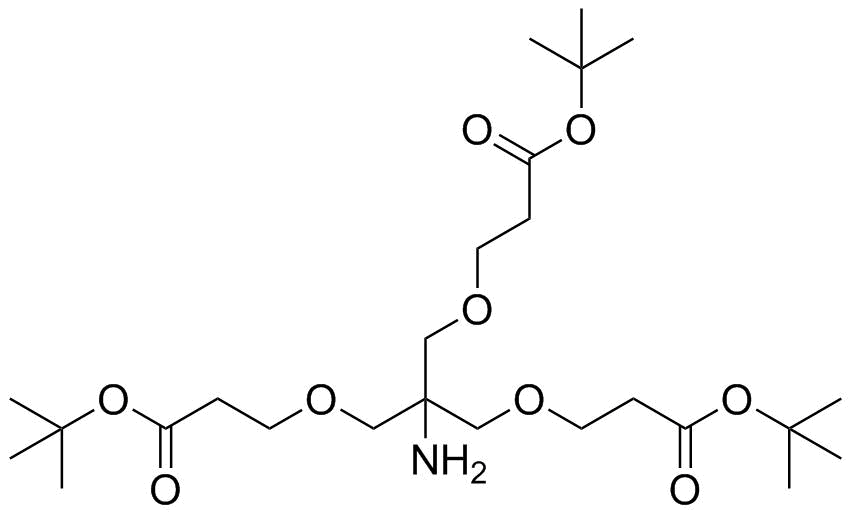 |
| Molecular Formula | C25H47NO9 |
| Molecular Weight | 505.64 |
| CAS Registry Number | 175724-30-8 |
| SMILES | CC(C)(C)OC(=O)CCOCC(COCCC(=O)OC(C)(C)C)(COCCC(=O)OC(C)(C)C)N |
| Density | 1.1±0.1 g/cm3 Calc.* |
|---|---|
| Boiling point | 543.0±50.0 °C 760 mmHg (Calc.)* |
| Flash point | 86.0±26.4 °C (Calc.)* |
| Index of refraction | 1.468 (Calc.)* |
| * | Calculated using Advanced Chemistry Development (ACD/Labs) Software. |
| Hazard Symbols |  GHS07 Warning Details |
|---|---|
| Risk Statements | H302-H315-H319-H335 Details |
| Safety Statements | P261-P264-P270-P271-P280-P301+P312-P302+P352-P304+P340-P305+P351+P338-P330-P332+P313-P337+P313-P362-P403+P233-P405-P501 Details |
| SDS | Available |
 chemBlink Chemical Story
|
Tris[[2-(tert-butoxycarbonyl)ethoxy]methyl]methylamine is a branching reagent with one free primary amine and three equivalent arms ending in tert-butyl esters. Its long name can be misleading if the words tert-butoxycarbonyl are automatically interpreted as nitrogen protection. In this molecule, the nitrogen is unprotected. The three tert-butyl groups protect carboxylic acids at the ends of the arms; they are not three Boc groups on the amine, nor do they represent protected hydroxyl groups. The architecture can be understood as a central carbon bearing an amino group and three methylene-ether arms. Each arm continues through an ethylene segment to an ester. This gives the molecule one type of connection at its center and a different, temporarily masked type at its periphery. It is a discrete compound, C25H47NO9, rather than a polymer with an unspecified distribution of chain lengths. The free amine can be coupled to a suitable acid or activated ester, while subsequent deprotection makes three acid termini available for further assembly. Patent EP4444357B1 provides a specific example in the construction of trivalent GalNAc-containing linkers and solid supports. It identifies the reagent by CAS 175724-30-8 and describes first connecting its amino group to a spacer. Removal of the peripheral tert-butyl groups then provides a tricarboxylic-acid intermediate for attachment of sugar-containing arms. The sequence illustrates the practical advantage of distinguishing one central attachment point from three outward-facing functions. GalNAc denotes N-acetylgalactosamine. In the patent, this branching scaffold becomes part of a larger conjugate-building strategy; the starting reagent contains no GalNAc units and is not itself an oligonucleotide-delivery medicine. Likewise, the presence of three arms does not by itself prove improved cellular uptake. Any biological effect belongs to a characterized final construct and must be evaluated in that context. The example explains why the sequence is deliberately asymmetric even though the three arms are equivalent. The central amine is used first to install a single spacer, while the peripheral acid functions remain masked. Once those ester groups are deprotected, several sugar-containing arms can be attached to the outward-facing acid positions. The chemist is not selecting one of three equivalent arms at random: the single central nitrogen provides a chemically distinct starting connection. GalNAc-containing conjugates are investigated as a way of linking a biological recognition element to another molecular cargo. For this reagent, however, the directly documented contribution is architectural. It provides the branching center from which several sugar-bearing arms can extend. The spacer, sugar derivatives, oligonucleotide, and solid support described in the patent are additional components introduced during construction, not parts already present in the catalog reagent. That distinction also helps when reading the chemical name. The three ether linkages are embedded in the arms and remain different from the terminal ester functions. Unmasking a tert-butyl ester reveals a carboxylic acid; it does not reveal an alcohol at that position. Identifying which group is actually being protected is what connects a long systematic name to a sensible synthetic plan. In this case, a single amine and three masked acids provide an ordered way to construct a branched conjugate. The useful idea is controlled multiplicity. Chemists can first connect a single hub to a spacer and then elaborate several arms, instead of attempting to attach unrelated components indiscriminately. The protecting groups organize that order of operations. This makes the compound a meaningful example of how apparently repetitive molecular architecture can serve a precise synthetic purpose, while reminding readers that the design potential of a linker and the demonstrated performance of a complete conjugate are different kinds of evidence. References: 1. Ambeed via Sigma-Aldrich. CAS 175724-30-8: molecular structure and InChI. https://www.sigmaaldrich.com/US/en/product/ambeedinc/ambh9884d620 2. BroadPharm. Amino-Tri-(t-butoxycarbonylethoxymethyl)-methane, BP-20943. https://broadpharm.com/product/bp-20943 3. EP4444357B1. ARNATAR compounds and methods for enhanced cellular uptake; Example 1. https://patents.google.com/patent/EP4444357B1/en |
| Market Analysis Reports |