
Online Database of Chemicals from Around the World
| Jiangsu Juming Chemical Technology Co., Ltd. | China | |||
|---|---|---|---|---|
 | en.jmchemchina.com | |||
 | +86 17798763151 | |||
 | admin@jumingchem.com | |||
| Chemical manufacturer since 2017 | ||||
| chemBlink Standard supplier since 2026 | ||||
| Classification | Flavors and spices >> Synthetic spice >> Halogen-containing, sulfur-containing, nitrogen-containing compounds >> Halogen-containing compound |
|---|---|
| Name | 1,5-Dibromo-3-fluoro-2,4-dimethylbenzene |
| Molecular Structure | 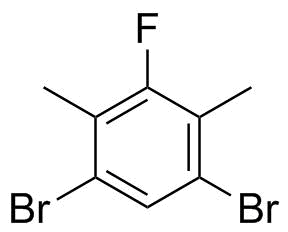 |
| Molecular Formula | C8H7Br2F |
| Molecular Weight | 281.95 |
| CAS Registry Number | 1781113-11-8 |
| SMILES | CC1=C(C(=C(C=C1Br)Br)C)F |
| Density | 1.8±0.1 g/cm3 Calc.* |
|---|---|
| Boiling point | 258.9±35.0 °C 760 mmHg (Calc.)* |
| Flash point | 110.4±25.9 °C (Calc.)* |
| Index of refraction | 1.56 (Calc.)* |
| * | Calculated using Advanced Chemistry Development (ACD/Labs) Software. |
| Hazard Symbols |  GHS07 Warning Details GHS07 Warning Details |
|---|---|
| Risk Statements | H315-H319-H335 Details |
| Safety Statements | P261-P264-P271-P280-P302+P352-P304+P340-P305+P351+P338-P312-P362-P403+P233-P501 Details |
| SDS | Available |
 chemBlink Chemical Story
|
1,5-Dibromo-3-fluoro-2,4-dimethylbenzene, CAS 1781113-11-8, is not notable because it is a finished drug, pigment or electronic material. Its value lies in being a deliberately prefunctionalized aromatic building block. The benzene ring carries two bromine atoms, one fluorine atom and two methyl groups, leaving only one aromatic hydrogen. That dense substitution pattern gives a synthetic chemist several chemically distinct positions whose reactivity can be exploited in later steps. The two aryl carbon-bromine bonds are the most obvious synthetic handles. Aryl bromides are widely used in palladium-catalyzed cross-coupling reactions such as Suzuki-Miyaura carbon-carbon coupling and Buchwald-Hartwig carbon-nitrogen coupling. Under suitably chosen conditions, one or both brominated positions can be replaced by larger fragments. The aryl carbon-fluorine bond is much stronger and is often retained under conditions that transform aryl bromides, allowing fluorine to remain as a permanent substituent while the bromine atoms serve as construction sites. The two methyl groups are not passive decorations either. They alter the electronic environment of the ring and, because they occupy positions adjacent to other substituents, they can create steric congestion that affects coupling rates and the conformations of products built from this core. In medicinal chemistry, fluorine and methyl groups are often used to tune properties of final molecules; in materials chemistry, substitution patterns can influence packing and electronic structure. For this exact compound, however, public literature does not establish one dominant downstream product, so assigning a specific pharmaceutical or optoelectronic application would go beyond the evidence. This is a useful example of how complex synthesis is actually organized. Large molecules are rarely assembled in a single transformation. Chemists instead prepare intermediates in which certain positions are intentionally activated and others are intentionally preserved. Halogenated aromatic compounds are particularly effective in this role because different carbon-halogen bonds can show different reactivity, making sequential functionalization possible. Database records confirm the formula C8H7Br2F and the substitution pattern for CAS 1781113-11-8. The chemistry that makes the molecule interesting is therefore not mysterious: two relatively reactive aryl bromides coexist with a more persistent aryl fluoride and two sterically influential methyl groups. Its story is the story of synthetic planning. A small benzene derivative becomes useful because several future reaction pathways have already been encoded into its substitution pattern. References: 1. PubChem, 1,5-Dibromo-3-fluoro-2,4-dimethylbenzene, CID 84812184. 2. ChemicalBook, CAS 1781113-11-8. 3. Miyaura N, Suzuki A. Palladium-catalyzed cross-coupling reactions of organoboron compounds. Chem Rev. 1995;95:2457-2483. DOI: 10.1021/cr00039a007. |
| Market Analysis Reports |