
Online Database of Chemicals from Around the World
| Shanghai PI Chemicals Ltd. | China | |||
|---|---|---|---|---|
 | www.pipharm.com | |||
 | +86 (21) 58953700 | |||
 | +86 (21) 58953701 | |||
 | sales@pipharm.com | |||
| Chemical distributor since 2007 | ||||
| chemBlink Standard supplier since 2026 | ||||
| Classification | Organic raw materials >> Carboxylic compounds and derivatives >> Carboxylic esters and their derivatives |
|---|---|
| Name | Fmoc-PEG6-NHS ester |
| Synonyms | (2,5-dioxopyrrolidin-1-yl) 3-[2-[2-[2-[2-[2-[2-(9H-fluoren-9-ylmethoxycarbonylamino)ethoxy]ethoxy]ethoxy]ethoxy]ethoxy]ethoxy]propanoate |
| Molecular Structure | 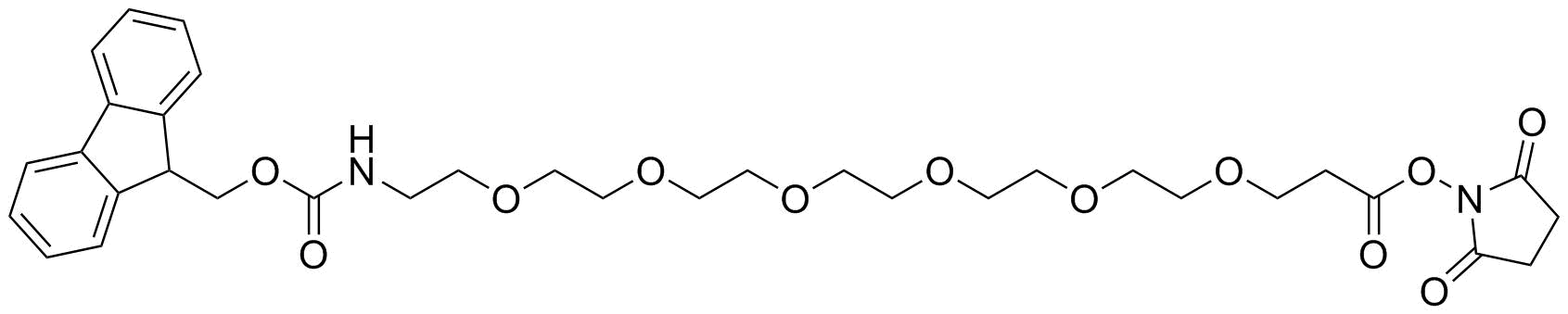 |
| Molecular Formula | C34H44N2O12 |
| Molecular Weight | 672.73 |
| CAS Registry Number | 1818294-31-3 |
| SMILES | C1CC(=O)N(C1=O)OC(=O)CCOCCOCCOCCOCCOCCOCCNC(=O)OCC2C3=CC=CC=C3C4=CC=CC=C24 |
| Density | 1.3±0.1 g/cm3 Calc.* |
|---|---|
| Index of refraction | 1.575 (Calc.)* |
| * | Calculated using Advanced Chemistry Development (ACD/Labs) Software. |
| Hazard Symbols |  GHS07 Warning Details |
|---|---|
| Risk Statements | H302-H315-H319 Details |
| Safety Statements | P501-P270-P264-P280-P302+P352-P337+P313-P305+P351+P338-P362+P364-P332+P313-P301+P312+P330 Details |
| SDS | Available |
 chemBlink Chemical Story
|
Fmoc-PEG6-NHS ester contains an activated ester and a protected amine separated by a chain with six ether oxygens. Its formula is C₃₄H₄₄N₂O₁₂. The carboxyl-derived end is an N-hydroxysuccinimide ester, while Fmoc masks the amino nitrogen as a carbamate. It is therefore neither a free amino acid nor a diamine, despite containing two nitrogens in the full formula. The distinction between activation and protection explains the design. Activation makes the acid-derived end suitable for transfer to a chosen amine. Protection prevents the reagent's own amino terminus from participating as an ordinary free amine at that stage. After successful amide formation, the covered end can be exposed in an appropriate later step, providing another point for molecular construction. The NHS group is consumed during the desired attachment. Its nitrogen leaves with N-hydroxysuccinimide instead of becoming a second nitrogen handle on the product. Conversely, the Fmoc-protected nitrogen can remain attached to the chain after its cover is removed. Following those different atom destinations is more informative than calling both ends reactive without qualification. This active ester can also react with unintended amines in the surrounding medium. An amine-containing buffer may compete with the chosen partner, while water can hydrolyze the ester to an acid. Neither pathway establishes the desired conjugation. The intended product, a buffer-derived adduct and the hydrolyzed linker are different substances, even if all preserve a recognizable ether-rich segment. The six-unit chain distinguishes this reagent from longer Fmoc-protected NHS esters. It supplies a different specified composition while retaining the same broad classes of end-group chemistry. A comparison of chain lengths can be meaningful, but a longer or shorter version is not automatically more selective or more effective. The attachment site and the rest of the completed structure also matter. The accessible evidence establishes a research reagent for sequential functionalization more clearly than a compound-specific discovery history or a demonstrated medical application. Its useful angle is chemical bookkeeping: one end begins activated, one begins covered, and the desired sequence changes both. Successful molecular design requires identifying the intermediate that actually exists after each operation, rather than assuming that the starting name continues to describe every later product. References: 1. PubChem. Fmoc-PEG6-NHS ester, CID 77078440, CAS 1818294-31-3. https://pubchem.ncbi.nlm.nih.gov/compound/77078440 2. BroadPharm. Fmoc-PEG6-NHS ester, BP-21633, molecular specification and reaction functions. https://broadpharm.com/product/bp-21633 3. Thermo Fisher Scientific. Amine-Reactive Crosslinker Chemistry, NHS ester reactions and buffer competition. https://www.thermofisher.com/us/en/home/life-science/protein-biology/protein-biology-learning-center/protein-biology-resource-library/pierce-protein-methods/amine-reactive-crosslinker-chemistry.html |
| Market Analysis Reports |