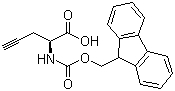
Fmoc-L-propargylglycine is a protected amino acid that introduces a terminal alkyne into a peptide. Its side chain is –CH₂–C≡CH, attached to the alpha carbon of an L-amino-acid framework. The Fmoc group covers the amino function while leaving the carboxylic acid available for peptide assembly. The alkyne is not part of the peptide backbone: it projects from the side chain and offers a later point of chemical modification.
That separation of roles is the appeal of the reagent. A chemist can use the carboxyl and amino functions to place the residue at a selected position in a sequence, then use the alkyne in a different transformation. The Fmoc group is temporary, while the side-chain carbon skeleton is retained in the peptide until it is deliberately modified. The original reagent, an incorporated residue and a cycloaddition product therefore have different compositions. A mass calculation for the final peptide cannot simply add the entire mass of the protected starting amino acid.
Terminal alkynes can react with organic azides in copper-catalyzed azide–alkyne cycloaddition, commonly called CuAAC. The triple bond and the azide form a five-membered triazole ring, making a new connection between the original partners. For the usual CuAAC transformation, the product is the 1,4-disubstituted triazole. This gives an alkyne-bearing residue a role beyond being an unusual side chain. It provides a chemically addressable position for joining another component, subject to the compatibility of the full molecule and the reaction conditions.
A specific application was reported by Punna, Kuzelka, Wang and Finn in 2005. They investigated head-to-tail peptide cyclodimerization through copper-catalyzed azide–alkyne chemistry. Their supporting information explicitly identifies Fmoc- and Boc-protected L-propargylglycine and describes incorporation into peptides. The paper is therefore stronger evidence than a general statement that an alkyne might be useful. It documents how protected amino-acid chemistry was integrated with a later ring-forming strategy.
Cyclodimerization also poses an instructive structural question. Closing a ring within one chain and connecting two chains into a larger ring are different outcomes, even when both consume azide and alkyne groups. A successful cycloaddition does not by itself reveal which topology was formed. The number and placement of the reacting handles, together with the behavior of the peptide under the chosen conditions, determine which assemblies are accessible. Product characterization has to establish the final molecular object rather than merely the disappearance of a triple bond.
The L designation adds another requirement. It identifies the intended stereochemistry of the amino-acid center; it does not mean that an alkyne has somehow made all steps immune to epimerization. The cited supporting information discusses coupling choices intended to limit racemization. This is a reminder that orthogonal chemical handles can still coexist with sensitive stereochemical centers.
The triple bond here is a terminal, unstrained alkyne. It should not be confused with the strained cycloalkynes used in some copper-free azide ligations. Both approaches can produce triazoles, but their starting structures and reaction requirements differ. An application described as click chemistry still needs to identify which pair of handles and which transformation were used. The name propargylglycine specifies the first handle, not every possible method for connecting it.
Its documented significance is thus architectural. Fmoc-L-propargylglycine allows a peptide sequence to carry a chosen site for a later connection, linking ordinary backbone construction to triazole formation and cyclic assemblies. Those products require their own evidence for biological behavior. The isolated protected reagent contributes a synthetic handle, not a predetermined therapeutic effect.
References:
1. PubChem. Fmoc-L-propargylglycine, CID 2734461. https://pubchem.ncbi.nlm.nih.gov/compound/2734461
2. Punna S, Kuzelka J, Wang Q, Finn MG. Head-to-tail peptide cyclodimerization by copper-catalyzed azide-alkyne cycloaddition. Angew Chem Int Ed. 2005;44:2215–2220. https://doi.org/10.1002/anie.200461656
3. Punna et al. Supporting information, protected L-propargylglycine incorporation and peptide cyclization. https://application.wiley-vch.de/contents/jc_2002/2005/z461656_s.pdf
|





 GHS07 Warning Details
 chemBlink Chemical Story