
Online Database of Chemicals from Around the World
| Changzhou Ditong Chemical Co., Ltd. | China | |||
|---|---|---|---|---|
 | www.edengenechem.com | |||
 | +86 (519) 8829-8848 +86 18118010980 | |||
 | info@edengenechem.com sale@edengenechem.com | |||
 | QQ Chat | |||
 | WeChat: 18118010980 | |||
| Chemical manufacturer since 2006 | ||||
| chemBlink Premium supplier since 2026 | ||||
| Classification | Organic raw materials >> Ketone compound |
|---|---|
| Name | 4'-Dimethylaminoacetophenone |
| Synonyms | 1-[4-(Dimethylamino)phenyl]ethanone; 4'-(N,N-Dimethylamino)acetophenone |
| Molecular Structure | 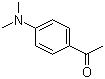 |
| Molecular Formula | C10H13NO |
| Molecular Weight | 163.22 |
| CAS Registry Number | 2124-31-4 |
| EC Number | 642-894-0 |
| SMILES | CC(=O)C1=CC=C(C=C1)N(C)C |
| Density | 1.0±0.1 g/cm3 Calc.* |
|---|---|
| Melting point | 105 °C (Expl.) |
| Boiling point | 282.9±23.0 °C 760 mmHg (Calc.)* |
| Flash point | 107.0±12.0 °C (Calc.)* |
| Index of refraction | 1.549 (Calc.)* |
| * | Calculated using Advanced Chemistry Development (ACD/Labs) Software. |
| Hazard Symbols |  GHS07 Warning Details GHS07 Warning Details | ||||||||||||||||||||
|---|---|---|---|---|---|---|---|---|---|---|---|---|---|---|---|---|---|---|---|---|---|
| Risk Statements | H302 Details | ||||||||||||||||||||
| Safety Statements | P264-P270-P301+P317-P330-P501 Details | ||||||||||||||||||||
| Hazard Classification | |||||||||||||||||||||
| |||||||||||||||||||||
| SDS | Available | ||||||||||||||||||||
 chemBlink Chemical Story
|
4'-Dimethylaminoacetophenone is an aromatic ketone belonging to the class of substituted acetophenones. It consists of an acetophenone core, in which an acetyl group is attached to a benzene ring, with a dimethylamino substituent located at the para (4') position relative to the carbonyl group. The compound is characterized by an electron-rich aromatic system containing a conjugated donor–acceptor arrangement. The molecular framework is based on acetophenone, which contains a benzene ring bonded to an acetyl group (–COCH3). In 4'-dimethylaminoacetophenone, the para position of the benzene ring carries a dimethylamino group (–N(CH3)2). This substitution pattern creates a push–pull electronic system in which the dimethylamino group acts as an electron donor and the carbonyl group acts as an electron acceptor. The benzene ring is a planar aromatic system containing six delocalized π-electrons. The para arrangement of the dimethylamino and acetyl substituents allows efficient resonance interaction across the aromatic ring. Electron density can be donated from the nitrogen lone pair into the aromatic π-system and transmitted toward the carbonyl-containing substituent. The dimethylamino group contains a tertiary amine nitrogen bonded to two methyl groups and the aromatic carbon. The nitrogen atom is sp2-hybridized to some extent because its lone pair can overlap with the aromatic π-system. This resonance donation reduces the availability of the lone pair for protonation compared with simple aliphatic tertiary amines, although the nitrogen can still act as a weak base. The acetyl substituent contains a ketone functional group. The carbonyl carbon is sp2-hybridized and adopts trigonal planar geometry. The carbonyl oxygen contains two lone pairs and serves as a hydrogen bond acceptor. The carbonyl group is strongly polarized, with partial positive charge on the carbonyl carbon and partial negative charge on the oxygen atom. The conjugation between the dimethylamino group, aromatic ring, and carbonyl group results in an extended π-electron system. This conjugated arrangement influences the compound’s optical properties by lowering the energy required for electronic excitation. As a result, substituted aminoacetophenones commonly show characteristic absorption in the ultraviolet and visible regions. The molecule is largely planar because conjugation favors alignment of the aromatic ring, dimethylamino group, and carbonyl system. However, steric interactions involving the dimethylamino methyl groups and neighboring hydrogen atoms may cause slight deviations from complete coplanarity. From a physicochemical perspective, 4'-dimethylaminoacetophenone contains both polar and nonpolar regions. The aromatic ring and methyl groups contribute hydrophobic character, while the tertiary amino group and carbonyl oxygen provide polarity. The molecule can participate in hydrogen bonding as an acceptor through the carbonyl oxygen and amine nitrogen but lacks hydrogen bond donor groups because it contains no N–H or O–H bonds. Chemically, the carbonyl group undergoes reactions typical of aromatic ketones, including nucleophilic addition reactions and reduction to the corresponding secondary alcohol. The tertiary amino group can undergo protonation to form ammonium salts and can participate in electrophilic substitution reactions involving the aromatic system. The electron-rich aromatic ring is activated toward electrophilic aromatic substitution, particularly at positions influenced by the strongly donating dimethylamino group. However, the para-substituted arrangement limits the number of available substitution sites and affects reaction selectivity. Overall, 4'-dimethylaminoacetophenone is a conjugated aromatic ketone containing a para-dimethylamino electron-donating group and an acetyl electron-withdrawing group. Its donor–acceptor electronic structure, resonance stabilization, and characteristic carbonyl and tertiary amine functionalities define its chemical properties and make it a representative compound of substituted aminoacetophenones. References 2026. Synthesis of thiazole linked pyrimidine and chalcone derivatives: in-vitro anticancer studies and in-silico molecular docking simulations. Chemical Papers. DOI: 10.1007/s11696-025-04554-y 2025. Synthesis and Structure of 4-Acetyl-N,N,N-Trimethylanilinium Iodide. Journal of Structural Chemistry. DOI: 10.1134/s0022476625090197 2023. Multimodal action of KRP203 on phosphoinositide kinases in vitro and in cells. Biochemical and Biophysical Research Communications. DOI: 10.1016/j.bbrc.2023.08.050 |
| Market Analysis Reports |