
Online Database of Chemicals from Around the World
| Pharmaccare | UK | |||
|---|---|---|---|---|
 | www.pharmaccare.com | |||
 | +44 7362050789 | |||
 | duranjohnson16@gmail.com | |||
| Chemical distributor since 2020 | ||||
| chemBlink Standard supplier since 2026 | ||||
| Classification | Organic raw materials >> Heterocyclic compound >> Imidazoles |
|---|---|
| Name | N-Desethylisotonitazene |
| Synonyms | N-ethyl-2-[5-nitro-2-[(4-propan-2-yloxyphenyl)methyl]benzimidazol-1-yl]ethanamine |
| Molecular Structure | 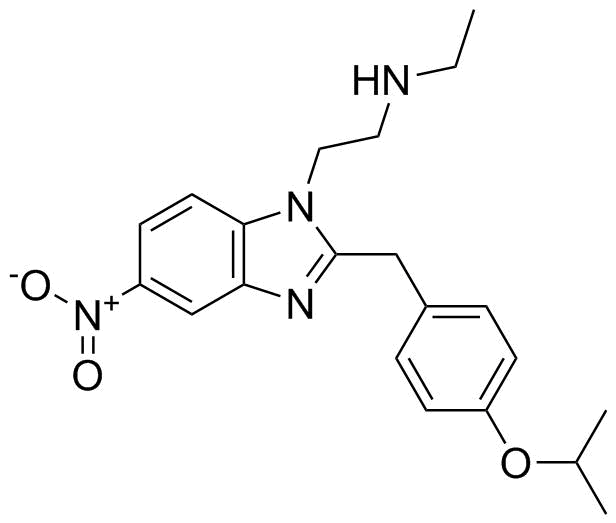 |
| Molecular Formula | C21H26N4O3 |
| Molecular Weight | 382.46 |
| CAS Registry Number | 2732926-24-6 |
| SMILES | CCNCCN1C2=C(C=C(C=C2)[N+](=O)[O-])N=C1CC3=CC=C(C=C3)OC(C)C |
| Density | 1.2±0.1 g/cm3 Calc.* |
|---|---|
| Boiling point | 585.6±45.0 °C 760 mmHg (Calc.)* |
| Flash point | 307.9±28.7 °C (Calc.)* |
| Index of refraction | 1.605 (Calc.)* |
| * | Calculated using Advanced Chemistry Development (ACD/Labs) Software. |
 chemBlink Chemical Story
|
N-Desethylisotonitazene shows why a metabolite cannot automatically be assumed to be less active than its parent compound. It belongs to the nitazene family of synthetic opioids, which has a 2-benzylbenzimidazole framework rather than the structure of fentanyl. Its name describes removal of one ethyl substituent from the amino group of isotonitazene. That apparently modest chemical change leaves a compound capable of strongly activating the mu-opioid receptor. Understanding the difference between metabolism and detoxification is central to its scientific story. N-Deethylation changes a tertiary amino group into a secondary one. It does not remove the entire nitrogen-containing side chain, and it is distinct from removing the nitro group elsewhere on the molecule. This matters both for naming and for analytical identification: related nitazenes and their metabolites can differ at several positions, so a shortened name or a shared structural class is insufficient to establish which substance has been detected. The compound can be investigated as a metabolite while also being monitored as a substance present in its own right in illicit drug samples. In a 2021 study, Vandeputte and colleagues examined a group of nitazenes and metabolites using cellular assays that monitored mu-opioid receptor activation through two signaling readouts. N-Desethylisotonitazene was notably potent in those experiments, exceeding the parent isotonitazene in the reported assay systems. The finding challenged a simple expectation that losing an alkyl group necessarily weakens opioid activity. It also demonstrated why identifying metabolites can matter to toxicology even when the parent compound is already included in an analytical panel. A 2023 investigation by Malcolm and colleagues extended the work to several receptor-signaling measurements and experimental respiratory effects. It characterized high-efficacy mu-opioid receptor activation and prolonged respiratory depression in an animal model. Importantly, potency rankings are not universal constants: the relative position of N-desethylisotonitazene and its parent differed with the experimental method. A statement that one compound is always a fixed number of times stronger than another loses the assay, endpoint, and biological system that make the comparison interpretable. The World Health Organization's 2024 critical review brought together pharmacological, toxicological, and forensic information on the substance. It described its use as a reference material in scientific and forensic work and reported no known medical use. The report also discussed detection alongside other drugs and as a component of illicit products. Such observations require careful interpretation: detecting a metabolite in a biological specimen does not, by itself, establish direct consumption of that metabolite, and co-detection in a fatal case does not assign a separate causal contribution to each substance. Its legitimate research importance therefore lies in understanding opioid action, improving identification, and interpreting toxicological evidence. A reference standard helps establish an analytical comparison; it does not make the material a therapeutic product. Likewise, receptor potency alone is not a clinical dose, a safety threshold, or a complete prediction of an individual's response. For this compound, precise chemical identification and a clear separation between laboratory measurements, animal findings, and human observations are essential. The broader lesson is that even a small metabolic modification can preserve substantial pharmacological activity, making careful investigation of both parent compounds and metabolites indispensable. Analytical interpretation also depends on the specimen and the question being asked. Identification in a seized product concerns its composition, whereas identification in blood or urine concerns exposure and potentially metabolism. The same chemical name can therefore appear in records that answer quite different questions and should not be merged without context. References: 1. Vandeputte MM et al. Synthesis, Chemical Characterization, and mu-Opioid Receptor Activity Assessment of the Emerging Group of Nitazene 2-Benzylbenzimidazole Synthetic Opioids. ACS Chem Neurosci. 2021;12:1241-1251. DOI: 10.1021/acschemneuro.1c00064. https://pubmed.ncbi.nlm.nih.gov/33759494/ 2. Malcolm NJ et al. Mu-opioid receptor selective superagonists produce prolonged respiratory depression. iScience. 2023;26:107121. DOI: 10.1016/j.isci.2023.107121. https://doi.org/10.1016/j.isci.2023.107121 3. WHO Expert Committee on Drug Dependence. Critical review report: N-Desethyl-isotonitazene. 47th meeting, 2024. https://cdn.who.int/media/docs/default-source/controlled-substances/47th-ecdd/n-desethyl-isotonotazene-47th-ecdd-critical-review-public-version.pdf |
| Market Analysis Reports |