
Online Database of Chemicals from Around the World
| Shanghai RC Chemicals Co., Ltd. | China | |||
|---|---|---|---|---|
 | www.rcc.net.cn | |||
 | +86 (21) 5032-2175 5866-1250 ex 603 | |||
 | +86 (21) 5032-2176 / 5866-1251 | |||
 | sales@rcc.net.cn chad@rcc.net.cn | |||
| Chemical manufacturer since 2006 | ||||
| chemBlink Standard supplier since 2007 | ||||
| Simagchem Corporation | China | |||
|---|---|---|---|---|
| www.simagchem.com | |||
| +86 13806087780 | |||
| +86 (592) 268-0237 | |||
| sale@simagchem.com | |||
| Chemical manufacturer since 2002 | ||||
| chemBlink Standard supplier since 2008 | ||||
| Beyond Pharmatech Corporation Limited | China | |||
|---|---|---|---|---|
| www.beyond-pharma.com | |||
| +86 (571) 8195-3185 | |||
| +86 (571) 5811-0575 | |||
| sales@beyond-pharma.com | |||
| Chemical manufacturer | ||||
| chemBlink Standard supplier since 2010 | ||||
| BOC Sciences | USA | |||
|---|---|---|---|---|
| www.bocsci.com | |||
| +1 (631) 485-4226 | |||
| +1 (631) 614-7828 | |||
| info@bocsci.com | |||
| Chemical manufacturer | ||||
| chemBlink Standard supplier since 2010 | ||||
| Suzhou Myland Pharm & Nutrition Inc. | China | |||
|---|---|---|---|---|
| www.mylandpharm.com | |||
| +86 (512) 6615-0687 | |||
| +86 (512) 6615-7101 | |||
| info@mylandpharm.com | |||
 | QQ Chat | |||
| Chemical manufacturer since 2013 | ||||
| chemBlink Standard supplier since 2014 | ||||
| Cayman Chemical Company | USA | |||
|---|---|---|---|---|
| www.caymanchem.com | |||
| +1 (734) 971-3335 | |||
| +1 (734) 971-3640 | |||
| sales@caymanchem.com | |||
| Chemical manufacturer | ||||
| Changsha Chromar Pharmaceutical Techno. Co., Ltd. | China | |||
|---|---|---|---|---|
| www.chromar.com | |||
| +86 (731) 8469-7086 | |||
| +86 (731) 8476-3896 | |||
| 1249217438@qq.com | |||
| QQ Chat | |||
| Chemical manufacturer since 2002 | ||||
| Indofine Chemical Company, Inc. | USA | |||
|---|---|---|---|---|
| www.indofinechemical.com | |||
| +1 (888) 463-6346 | |||
| +1 (908) 359-1179 | |||
| info@indofinechemical.com | |||
| Chemical manufacturer since 1981 | ||||
| Santa Cruz Biotechnology, Inc. | USA | |||
|---|---|---|---|---|
| www.scbt.com | |||
| +1 (831) 457-3800 | |||
| +1 (831) 457-3801 | |||
| scbt@scbt.com | |||
| Chemical manufacturer | ||||
| Classification | Biochemical >> Inhibitor >> Endocrinology & hormones >> Estrogen/progestogen receptor agonist |
|---|---|
| Name | Equol |
| Synonyms | (S)-3,4-Dihydro-3-(4-hydroxyphenyl)-2H-1-benzopyran-7-ol |
| Molecular Structure | 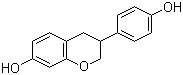 |
| Molecular Formula | C15H14O3 |
| Molecular Weight | 242.27 |
| CAS Registry Number | 531-95-3 |
| EC Number | 208-522-2 |
| SMILES | C1[C@H](COC2=C1C=CC(=C2)O)C3=CC=C(C=C3)O |
| Density | 1.3±0.1 g/cm3 Calc.* |
|---|---|
| Boiling point | 441.7±45.0 °C 760 mmHg (Calc.)* |
| Flash point | 220.9±28.7 °C (Calc.)* |
| Solubility | Soluble DMSO: 100 mM, ethanol:100 mM (Expl.) |
| Index of refraction | 1.645 (Calc.)* |
| * | Calculated using Advanced Chemistry Development (ACD/Labs) Software. |
| Hazard Symbols |  GHS07 Warning Details GHS07 Warning Details |
|---|---|
| Risk Statements | H315-H319-H335 Details |
| Safety Statements | P261-P305+P351+P338 Details |
| SDS | Available |
 chemBlink Chemical Story
|
Equol is a naturally occurring non-steroidal estrogenic compound belonging to the class of isoflavan derivatives. It is produced in humans and other animals through the intestinal microbial metabolism of the soybean isoflavone daidzein. Not all individuals possess gut microbiota capable of converting daidzein to equol; those who do are often referred to as “equol producers.” Structurally, equol is a dihydrodaidzein derivative with a characteristic 3-phenylchroman backbone. It contains two hydroxyl groups on the aromatic ring, which are key features for its biological interactions. The molecule exists as two enantiomers, R-equol and S-equol, with S-equol being the form predominantly produced in biological systems and the one most commonly associated with estrogen receptor activity. The formation of equol from daidzein occurs through a multistep microbial reduction process in the intestine. This involves the reduction of the double bond in the isoflavone structure and subsequent enzymatic transformations that yield the chiral dihydroisoflavan structure. This process is dependent on specific anaerobic bacterial species in the gut microbiome. Equol is structurally similar to 17β-estradiol in that it contains a phenolic ring system and a spatial arrangement of hydroxyl groups that allows binding to estrogen receptors. It exhibits preferential binding affinity for estrogen receptor beta (ERβ) over estrogen receptor alpha (ERα). This receptor selectivity is a key structural feature that distinguishes it from endogenous estrogens. From a physicochemical standpoint, equol contains both hydrophobic and hydrophilic regions. The fused aromatic system and phenyl group contribute hydrophobic character, while the phenolic hydroxyl groups provide polarity and hydrogen-bonding capability. This balance influences its solubility and distribution in biological systems. Equol exists as a chiral molecule, and its stereochemistry is important for receptor binding. The S-enantiomer has a three-dimensional configuration that more closely aligns with the geometry required for optimal estrogen receptor interaction. The R-enantiomer has significantly different biological activity due to its altered spatial arrangement. In biological systems, equol is considered a secondary metabolite derived from dietary intake rather than a directly ingested compound. Its presence in the body depends on both dietary soy isoflavone consumption and the composition of the gut microbiota. This interdependence between diet and microbiome is a well-documented aspect of equol biology. Chemically, the phenolic hydroxyl groups in equol can participate in hydrogen bonding and may undergo phase II metabolic transformations such as glucuronidation and sulfation in the liver. These conjugation reactions increase water solubility and facilitate excretion. Overall, equol is a microbiota-derived isoflavan metabolite characterized by a chiral dihydrobenzopyran structure with phenolic hydroxyl groups. Its significance lies in its estrogen receptor–modulating properties, stereochemical dependence, and origin as a gut microbial product of dietary isoflavones. References 2025. Comparative effectiveness of equol on estrogen and androgen disruption and metabolic parameters in adult male Sprague-Dawley rats. Ecotoxicology and Environmental Safety. DOI: 10.1016/j.ecoenv.2025.118606 2025. Equol neutralizes toxin B to combat Clostridioides difficile infection without disrupting the gut microbiota. Microbiological Research. DOI: 10.1016/j.micres.2025.128219 2025. Development and validation of a HPLC-MS/MS method the determination of genistein and equol in serum, urine and follicular fluid. Journal of Pharmaceutical and Biomedical Analysis. DOI: 10.1016/j.jpba.2025.116800 |
| Market Analysis Reports |