
Online Database of Chemicals from Around the World
| Shanghai Finetech pharm Co., Ltd. | China | |||
|---|---|---|---|---|
 | www.finetechpharm.cn | |||
 | +86 18221039705 | |||
 | ad@finetechpharm.cn | |||
| Chemical manufacturer since 2016 | ||||
| chemBlink Standard supplier since 2026 | ||||
| Classification | Organic raw materials >> Carboxylic compounds and derivatives >> Carboxylic esters and their derivatives |
|---|---|
| Name | Methyl 7-((1R,2S,3R,5S)-5-acetoxy-2-(hydroxymethyl)-3-((tetrahydro-2H-pyran-2-yl)oxy)cyclopentyl)heptanoate |
| Molecular Structure | 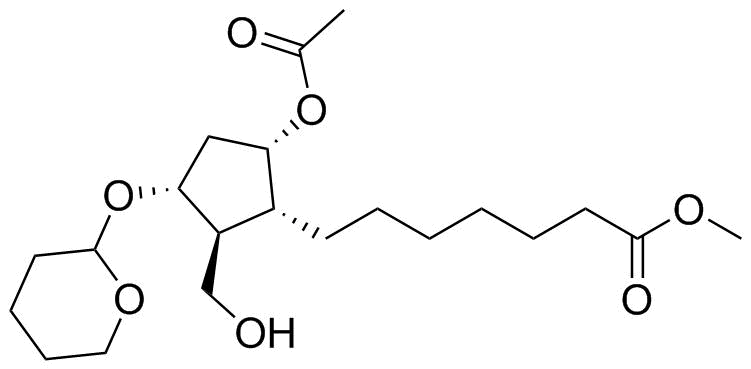 |
| Molecular Formula | C21H36O7 |
| Molecular Weight | 400.51 |
| CAS Registry Number | 61302-47-4 |
| SMILES | CC(=O)O[C@H]1C[C@H]([C@@H]([C@H]1CCCCCCC(=O)OC)CO)OC2CCCCO2 |
| Density | 1.1±0.1 g/cm3 Calc.* |
|---|---|
| Boiling point | 496.1±45.0 °C 760 mmHg (Calc.)* |
| Flash point | 161.6±22.2 °C (Calc.)* |
| Index of refraction | 1.497 (Calc.)* |
| * | Calculated using Advanced Chemistry Development (ACD/Labs) Software. |
| Hazard Symbols |  GHS07 Warning Details GHS07 Warning Details |
|---|---|
| Risk Statements | H302-H315-H319-H335 Details |
| Safety Statements | P280-P305+P351+P338 Details |
| SDS | Available |
 chemBlink Chemical Story
|
Methyl 7-((1R,2S,3R,5S)-5-acetoxy-2-(hydroxymethyl)-3-((tetrahydro-2H-pyran-2-yl)oxy)cyclopentyl)heptanoate is a highly functionalized synthetic ester incorporating a cyclopentane-derived polyoxygenated core linked to a heptanoate side chain. The molecule contains multiple protecting groups and stereochemically defined centers, reflecting its role as an advanced intermediate in complex organic synthesis, particularly in the context of natural product-like molecule construction and medicinal chemistry scaffolds. Compounds of this structural complexity are typically encountered in modern synthetic organic chemistry, where polyfunctional intermediates are assembled through stepwise stereoselective transformations. The presence of a cyclopentane ring bearing multiple oxygen-containing substituents is characteristic of intermediates derived from carbohydrate-like building blocks or cyclopentanoid natural product frameworks. Such structures are often developed during research programs focused on the synthesis of biologically active lipids, prostaglandin analogs, or other oxygenated alicyclic compounds. The molecule contains several key functional features. The methyl heptanoate moiety represents an esterified medium-chain carboxylic acid derivative, which serves as a lipophilic tail and contributes to overall hydrophobicity. The cyclopentyl core is substituted with three oxygenated groups: an acetoxy substituent, a hydroxymethyl group, and a tetrahydropyran-protected hydroxyl group. These functionalities indicate that the compound is a protected intermediate designed to control chemoselectivity during multistep synthesis. The tetrahydro-2H-pyran-2-yl (THP) group is a well-established protecting group for alcohols in organic synthesis. Its presence in this molecule indicates that one of the hydroxyl groups is masked to prevent unwanted reactions during subsequent synthetic steps. THP protection is commonly used because it is stable under a range of neutral and basic conditions but can be selectively removed under mild acidic conditions. Similarly, the acetoxy group functions as a protected alcohol in ester form, which can later be hydrolyzed to regenerate the free hydroxyl group. The stereochemical specification (1R,2S,3R,5S) indicates that the cyclopentane ring contains four defined chiral centers. Stereochemical control is a critical aspect of modern synthetic chemistry, especially when intermediates are intended for the preparation of biologically active compounds, since spatial arrangement of functional groups can strongly influence biological interactions and downstream reactivity. The presence of multiple contiguous stereocenters suggests that the compound is derived from a stereoselective synthetic route or from a chiral pool starting material. Such multifunctional intermediates are often used in the synthesis of complex natural product analogs, where precise installation of oxygenated substituents on carbocyclic frameworks is required. Cyclopentane systems bearing oxygen functionality are common motifs in prostaglandin chemistry and related lipid signaling molecules. While this specific compound is not itself a known bioactive agent, its structural features are consistent with intermediates used in the construction of such frameworks. The heptanoate side chain provides a flexible aliphatic linker that can influence molecular conformation and reactivity. In synthetic applications, such chains are often introduced to modulate solubility, improve chromatographic properties, or serve as precursors for further functionalization. The ester linkage connecting the side chain to the cyclopentyl unit is chemically labile under hydrolytic conditions, allowing for later transformation into the corresponding carboxylic acid if required. From a physicochemical perspective, the molecule is expected to exhibit moderate to high hydrophobicity due to its long aliphatic chain and multiple protected oxygen functionalities, while still maintaining some polarity from ester and hydroxyl groups. The presence of multiple functional groups also enables hydrogen bonding interactions, which may influence its behavior in solution and solid-state packing. Overall, methyl 7-((1R,2S,3R,5S)-5-acetoxy-2-(hydroxymethyl)-3-((tetrahydro-2H-pyran-2-yl)oxy)cyclopentyl)heptanoate is a stereochemically defined, highly functionalized synthetic intermediate. Its significance lies in its role as a protected building block for complex oxygenated cyclopentane derivatives, reflecting modern strategies in multistep synthesis that rely on protecting group chemistry, stereochemical control, and modular assembly of functionalized carbon frameworks. |
| Market Analysis Reports |