
Online Database of Chemicals from Around the World
| Shanghai Finetech pharm Co., Ltd. | China | |||
|---|---|---|---|---|
 | www.finetechpharm.cn | |||
 | +86 18221039705 | |||
 | ad@finetechpharm.cn | |||
| Chemical manufacturer since 2016 | ||||
| chemBlink Standard supplier since 2026 | ||||
| Classification | Organic raw materials >> Carboxylic compounds and derivatives >> Carboxylic esters and their derivatives |
|---|---|
| Name | 3-Methyl-2-oxohept-5-ynylphosphonic acid dimethyl ester |
| Synonyms | 1-dimethoxyphosphoryl-3-methylhept-5-yn-2-one |
| Molecular Structure | 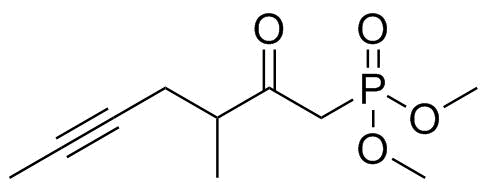 |
| Molecular Formula | C10H17O4P |
| Molecular Weight | 232.21 |
| CAS Registry Number | 70073-58-4 |
| EC Number | 885-774-5 |
| SMILES | CC#CCC(C)C(=O)CP(=O)(OC)OC |
| Density | 1.1±0.1 g/cm3 Calc.* |
|---|---|
| Boiling point | 328.0±27.0 °C 760 mmHg (Calc.)* |
| Flash point | 165.9±44.1 °C (Calc.)* |
| Index of refraction | 1.45 (Calc.)* |
| * | Calculated using Advanced Chemistry Development (ACD/Labs) Software. |
| Hazard Symbols |  GHS07 Warning Details GHS07 Warning Details | ||||||||||||
|---|---|---|---|---|---|---|---|---|---|---|---|---|---|
| Risk Statements | H315-H319 Details | ||||||||||||
| Safety Statements | P264-P280-P302+P352-P305+P351+P338-P332+P313-P337+P313-P362 Details | ||||||||||||
| Hazard Classification | |||||||||||||
| |||||||||||||
| SDS | Available | ||||||||||||
 chemBlink Chemical Story
|
3-Methyl-2-oxohept-5-ynylphosphonic acid dimethyl ester is a synthetic organophosphorus compound containing a phosphonate ester group attached to an aliphatic chain that also bears a ketone and an internal alkyne functionality. It belongs to the class of alkynyl and keto-substituted phosphonates, which are multifunctional intermediates widely used in organic synthesis for carbon–carbon bond formation and heteroatom-functional group transformations. Organophosphonates have been studied extensively since the mid-twentieth century, when the chemistry of phosphorus–carbon bonds became an important branch of synthetic organic chemistry. Unlike phosphate esters, phosphonates contain a direct carbon–phosphorus bond, which imparts greater hydrolytic stability. This stability, combined with their reactivity under basic conditions, has made phosphonate esters valuable reagents in olefination reactions and other carbon skeleton-building processes. The structure of 3-methyl-2-oxohept-5-ynylphosphonic acid dimethyl ester features a seven-carbon backbone substituted with a methyl group at the 3-position, a ketone group at the 2-position, and a carbon–carbon triple bond at the 5-position. At one terminus, the molecule contains a dimethyl phosphonate ester group. This combination of functional groups gives the molecule multiple reactive sites that can be selectively transformed under different synthetic conditions. Phosphonate esters such as this compound are most widely known for their role in the Horner–Wadsworth–Emmons (HWE) reaction, a key carbon–carbon bond-forming method developed in the twentieth century. In this reaction, deprotonation of the phosphonate ester generates a stabilized carbanion that can react with aldehydes or ketones to form alkenes with defined stereochemistry. While the specific compound described here contains additional functional groups beyond the simplest HWE reagents, its phosphonate moiety places it within this broadly important class of synthetic intermediates. The presence of a ketone group at the 2-position introduces additional electrophilicity and synthetic flexibility. Carbonyl groups are among the most versatile functional groups in organic chemistry, capable of undergoing nucleophilic addition, reduction, condensation, and enolate chemistry. In combination with the phosphonate ester, this allows for sequential or orthogonal reactivity in multi-step synthesis strategies. The alkyne functionality at the 5-position further expands the compound’s synthetic utility. Alkynes are highly useful functional groups due to their ability to undergo a wide range of transformations, including hydrogenation, cycloaddition reactions, and metal-catalyzed coupling processes. The presence of an internal alkyne also introduces rigidity into the carbon chain, influencing molecular conformation and reactivity. Compounds containing both phosphonate and alkyne groups are frequently used in advanced organic synthesis, particularly in the construction of complex molecular architectures. The combination of multiple reactive sites allows chemists to perform selective transformations in a controlled sequence, making such molecules valuable as building blocks in medicinal chemistry and materials science. From a physicochemical perspective, 3-methyl-2-oxohept-5-ynylphosphonic acid dimethyl ester is expected to exhibit moderate polarity due to the presence of a polar phosphonate ester and a carbonyl group, balanced by a hydrophobic hydrocarbon chain. The dimethyl ester substitution increases lipophilicity relative to the corresponding phosphonic acid, while also enhancing stability and handling properties. Phosphonate esters are generally resistant to hydrolysis under neutral conditions but can be cleaved under strong acidic or basic environments. This property is important in both synthetic applications and in understanding the environmental behavior of organophosphorus compounds. The stability of the carbon–phosphorus bond is a defining feature that distinguishes phosphonates from other phosphorus-containing functional groups. Overall, 3-methyl-2-oxohept-5-ynylphosphonic acid dimethyl ester is a multifunctional organophosphorus compound incorporating ketone, alkyne, and phosphonate ester functionalities within a single molecular framework. Its significance lies in its potential use as a versatile intermediate in synthetic organic chemistry, particularly in reactions involving carbon–carbon bond formation and the stepwise construction of complex molecular structures. References 2016. Efficient synthesis of beraprost sodium. Chemical Research in Chinese Universities. DOI: 10.1007/s40242-016-6093-7 |
| Market Analysis Reports |