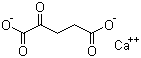
Calcium 2-oxoglutarate gets its name from a five-carbon dicarboxylic acid with a ketone beside one carboxyl group. Counting from that end puts the ketone at carbon 2; the same adjacency explains the older name alpha-ketoglutarate. Two carboxylate groups account for the negative charge of the fully deprotonated organic ion, and a calcium ion balances it. The salt has its own ingredient identity. Within a cell, however, the familiar metabolic name normally refers to the 2-oxoglutarate system in solution, without specifying calcium as its partner.
In the citric acid cycle, 2-oxoglutarate is formed from isocitrate and then undergoes oxidative decarboxylation to yield succinyl-CoA. One carbon leaves as carbon dioxide in the second step. The same five-carbon framework is linked to glutamate by reactions that exchange a carbonyl function for an amino group. This helps explain why 2-oxoglutarate connects routes that are often drawn on different classroom diagrams: pathways that oxidize carbon and pathways that transfer nitrogen. The organic ion also serves as a cosubstrate to enzymes that couple oxidation of other molecules with conversion of 2-oxoglutarate to succinate and carbon dioxide.
Interest in the calcium salt grew in part from research that used it to supply alpha-ketoglutarate in the diet of aging animals. A 2020 Cell Metabolism study included male and female mice that began receiving the intervention in middle age. The researchers tracked both survival and aspects of frailty. Several findings depended on sex and the endpoint studied. Frailty, survival and molecular markers are different kinds of outcomes; treating each as a direct synonym for aging would conceal what the experiment actually measured.
The study assessed frailty repeatedly using a composite index. Observers scored a series of features, including changes in coat, gait or posture, and results were compared over time. An index of this kind can detect differences across several visible or functional traits even when a single test does not change. In the same paper, for example, treated mice did not improve on a treadmill exhaustion test or on the reported echocardiographic measures of cardiac function. Those negative comparisons help define the scope of the positive findings. If the goal is to understand a biological mechanism, it matters which traits change together, which differ between sexes and which cannot be distinguished from the comparison group.
The material is listed by Health Canada under its chemical ingredient name. That record provides a way to confirm identity; the mouse paper provides evidence about an experimental intervention in a particular model. Neither kind of evidence establishes that a calcium salt reproduces the effect of changing 2-oxoglutarate metabolism inside a human cell, or that it extends human life. The scientific interest lies partly in devising experiments that can separate salt formulation, exposure and metabolic response.
References:
1. Health Canada NHPID, Calcium alpha-ketoglutarate. https://webprod.hc-sc.gc.ca/nhpid-bdipsn/ingredReq?id=7244
2. Asadi Shahmirzadi A et al. Alpha-ketoglutarate, an endogenous metabolite, extends lifespan and compresses morbidity in aging mice. Cell Metab. 2020;32:447–456.e6. https://pubmed.ncbi.nlm.nih.gov/32877690/
|







 GHS07 Warning Details
 chemBlink Chemical Story