
Online Database of Chemicals from Around the World
| INA Pharmaceuticals Pvt. Ltd. | India | |||
|---|---|---|---|---|
 | inapharma.in | |||
 | +91 7815933367 | |||
 | rd@inapharma.in | |||
| Chemical manufacturer since 2018 | ||||
| chemBlink Standard supplier since 2026 | ||||
| Classification | Chemical reagent >> Organic reagent >> Cyanate ester / isocyanate |
|---|---|
| Name | 2,6-Dichloro-3,5-dimethoxyphenyl isocyanate |
| Synonyms | 2,4-dichloro-3-isocyanato-1,5-dimethoxybenzene |
| Molecular Structure | 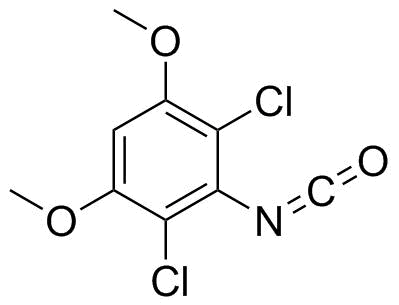 |
| Molecular Formula | C9H7Cl2NO3 |
| Molecular Weight | 248.06 |
| CAS Registry Number | 872511-32-5 |
| EC Number | 826-586-5 |
| SMILES | COC1=CC(=C(C(=C1Cl)N=C=O)Cl)OC |
| Density | 1.4±0.1 g/cm3 Calc.* |
|---|---|
| Boiling point | 343.3±42.0 °C 760 mmHg (Calc.)* |
| Flash point | 161.4±27.9 °C (Calc.)* |
| Index of refraction | 1.543 (Calc.)* |
| * | Calculated using Advanced Chemistry Development (ACD/Labs) Software. |
| Hazard Symbols |  GHS07 Warning Details GHS07 Warning Details | ||||||||
|---|---|---|---|---|---|---|---|---|---|
| Risk Statements | H317 Details | ||||||||
| Safety Statements | P261-P272-P280-P302+P352-P321-P333+P317-P362+P364-P501 Details | ||||||||
| Hazard Classification | |||||||||
| |||||||||
| SDS | Available | ||||||||
 chemBlink Chemical Story
|
2,6-Dichloro-3,5-dimethoxyphenyl isocyanate, CAS 872511-32-5, is a specialized aromatic isocyanate used mainly as an intermediate in organic and pharmaceutical synthesis. It is also described systematically as 2,4-dichloro-3-isocyanato-1,5-dimethoxybenzene. Its molecular formula is C9H7Cl2NO3 and its molecular weight is 248.06. Commercial suppliers identify it primarily as an organic synthesis or research intermediate rather than a finished functional product. ([Capot Chemical][1]) The most important part of the molecule is the isocyanate group, -N=C=O. Isocyanates occupy a valuable position in synthetic chemistry because the central carbon of this group is strongly electrophilic. Nucleophiles, particularly amines and alcohols, can attack this carbon and form new bonds. Reaction with an amine commonly produces a substituted urea, while reaction with an alcohol produces a carbamate, or urethane. This relatively direct conversion makes isocyanates useful intermediates for assembling molecules in which two larger structural fragments need to be connected through nitrogen-containing functionality. The aromatic ring in CAS 872511-32-5 is unusually highly substituted. Two chlorine atoms occupy the 2- and 6-positions relative to the isocyanate group, while two methoxy groups occupy the 3- and 5-positions. These substituents create a distinctive electronic and steric environment around the reactive -N=C=O group. More importantly for synthetic planning, the entire substituted aromatic unit can be incorporated into a larger molecule in a single reaction. This compound has a particularly well-documented connection with pharmaceutical research. Patent literature describes its reaction with N-[4-(4-ethylpiperazin-1-yl)phenyl]-N'-methylpyrimidine-4,6-diamine. The aromatic isocyanate reacts with the amine to produce a substituted urea, 3-(2,6-dichloro-3,5-dimethoxyphenyl)-1-{6-[4-(4-ethylpiperazin-1-yl)phenylamino]pyrimidin-4-yl}-1-methylurea. ([Justia Patents][2]) That complicated product has a much shorter pharmaceutical name: infigratinib, historically also known as BGJ398. Infigratinib is a small-molecule inhibitor of fibroblast growth factor receptors, or FGFRs, developed in oncology. Thus, CAS 872511-32-5 provides a useful real-world illustration of how a relatively obscure catalog chemical can contribute a recognizable structural fragment to a biologically active molecule. The chemistry of this transformation is conceptually simple despite the complexity of the final structure. One reaction partner already contains the substituted pyrimidine and piperazine-containing portion of the molecule. CAS 872511-32-5 supplies the dichloro-dimethoxyphenyl fragment together with the reactive isocyanate carbon. When the amine attacks the isocyanate, the two complex molecular pieces become connected through a urea linkage. This approach illustrates the modular nature of modern medicinal chemistry. A complicated drug candidate does not necessarily have to be constructed atom by atom in one continuous sequence. Chemists can first prepare relatively elaborate fragments, equip them with complementary reactive groups, and then connect them at a strategically chosen stage. Aromatic isocyanates are particularly useful in this strategy when the desired connection is a substituted urea. Urea linkages have become familiar structural elements in medicinal chemistry. Their two nitrogen atoms and carbonyl group provide a combination of hydrogen-bond donors and acceptors, while substitution on either side allows chemists to position different molecular fragments in three-dimensional space. These interactions can be important when a small molecule binds within a protein pocket. Nevertheless, the biological properties belong to the complete molecule; the isocyanate intermediate itself should not be assigned the pharmacological activity of a drug synthesized from it. This distinction is particularly relevant for CAS 872511-32-5. Its connection with infigratinib is supported by synthetic patent literature, but the intermediate is not itself an FGFR inhibitor simply because it contributes part of the drug's structure. Its practical value lies in its reactivity and in the precisely substituted aromatic fragment it delivers. The compound therefore provides an unusually clear example of the hidden molecular supply chain behind medicinal chemistry. A finished drug molecule may attract attention because of its biological target and clinical history, but its synthesis depends on less visible intermediates designed to perform specific construction tasks. CAS 872511-32-5 performs one such task: it carries a carefully substituted aromatic ring and presents it through an isocyanate group that can connect efficiently with an amine. Modern drug synthesis is often less like carving a complicated structure from a single starting material and more like assembling prepared molecular modules. In that process, a specialized intermediate may disappear as an independent chemical identity while its atoms remain embedded in the final molecule. 2,6-Dichloro-3,5-dimethoxyphenyl isocyanate is a good example of such molecular construction chemistry. References 1. Capot Chemical. 2,6-Dichloro-3,5-dimethoxyphenyl isocyanate, CAS 872511-32-5. Molecular formula C9H7Cl2NO3; molecular weight 248.06; application as an intermediate in organic synthesis. 2. U.S. Patent 9,067,896 B2. Crystalline forms of 3-(2,6-dichloro-3,5-dimethoxy-phenyl)-1-{6-[4-(4-ethyl-piperazin-1-yl)-phenylamino]-pyrimidin-4-yl}-1-methyl-urea and salts thereof. [https://patents.google.com/patent/US9067896B2/en](https://patents.google.com/patent/US9067896B2/en) 3. European Patent EP 2509963 B1. Crystalline forms of 3-(2,6-dichloro-3,5-dimethoxy-phenyl)-1-{6-[4-(4-ethyl-piperazin-1-yl)-phenylamino]-pyrimidin-4-yl}-1-methyl-urea and salts thereof. |
| Market Analysis Reports |