
Online Database of Chemicals from Around the World
| Pure Bio Medical Jiangsu Ltd. | China | |||
|---|---|---|---|---|
 | www.purejs.cn | |||
 | +86 (025) 8560-7383 | |||
 | jiangziwei@purejs.cn | |||
| Chemical manufacturer since 2019 | ||||
| chemBlink Standard supplier since 2026 | ||||
| Classification | Chemical reagent >> Organic reagent >> Amine salt (ammonium salt) |
|---|---|
| Name | Tafamidis Meglumine |
| Synonyms | 2-(3,5-dichlorophenyl)-1,3-benzoxazole-6-carboxylic acid;(2R,3R,4R,5S)-6-(methylamino)hexane-1,2,3,4,5-pentol |
| Molecular Structure | 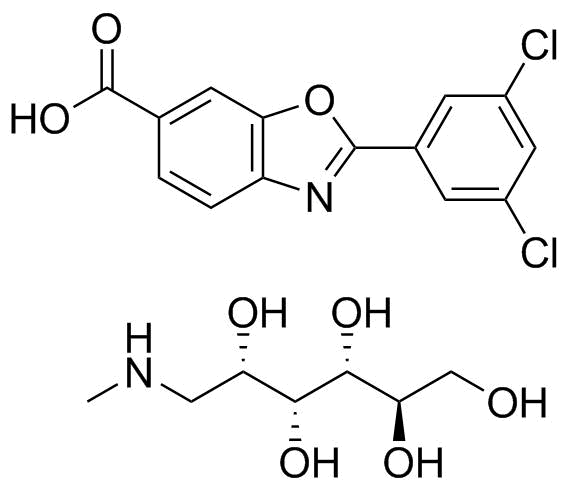 |
| Molecular Formula | C21H24Cl2N2O8 |
| Molecular Weight | 503.33 |
| CAS Registry Number | 951395-08-7 |
| EC Number | 813-716-0 |
| SMILES | CNC[C@@H]([C@H]([C@@H]([C@@H](CO)O)O)O)O.C1=CC2=C(C=C1C(=O)O)OC(=N2)C3=CC(=CC(=C3)Cl)Cl |
| Hazard Symbols |   GHS07;GHS08 Danger Details GHS07;GHS08 Danger Details | ||||||||||||||||||||||||||||||||||||
|---|---|---|---|---|---|---|---|---|---|---|---|---|---|---|---|---|---|---|---|---|---|---|---|---|---|---|---|---|---|---|---|---|---|---|---|---|---|
| Risk Statements | H302-H312-H315-H319-H332-H360-H360D-H362 Details | ||||||||||||||||||||||||||||||||||||
| Safety Statements | P203-P260-P261-P263-P264-P264+P265-P270-P271-P280-P301+P317-P302+P352-P304+P340-P305+P351+P338-P317-P318-P321-P330-P332+P317-P337+P317-P362+P364-P405-P501 Details | ||||||||||||||||||||||||||||||||||||
| Hazard Classification | |||||||||||||||||||||||||||||||||||||
| |||||||||||||||||||||||||||||||||||||
 chemBlink Chemical Story
|
Tafamidis meglumine is a pharmaceutical salt form of tafamidis, a small-molecule drug developed as a selective stabilizer of transthyretin (TTR). It is used in the treatment of transthyretin amyloidosis, a progressive disease in which misfolded transthyretin proteins aggregate into amyloid fibrils that deposit in tissues such as peripheral nerves and the heart. The meglumine component is a counterion that improves the solubility and formulation properties of tafamidis for oral administration. The active drug, tafamidis, was developed through medicinal chemistry efforts aimed at preventing the dissociation of the transthyretin tetramer. Under normal physiological conditions, transthyretin circulates in blood as a stable tetrameric protein responsible for transporting thyroxine and retinol-binding protein. Disease-associated amyloidosis begins when this tetramer dissociates into monomers, which misfold and aggregate into insoluble fibrils. Tafamidis binds selectively to the thyroxine-binding sites of transthyretin, stabilizing the tetramer and preventing its dissociation, thereby slowing amyloid formation. The discovery of tafamidis emerged from structure-based drug design studies that focused on identifying small molecules capable of binding within the central channel of the transthyretin tetramer. Researchers screened and optimized a series of benzoxazole derivatives to achieve high binding affinity and selectivity. The resulting compound showed strong stabilization of the native protein structure without significant off-target effects on other plasma proteins. Tafamidis meglumine is formed by combining tafamidis acid with N-methyl-D-glucamine (meglumine), a water-soluble amine that forms a stable salt. This salt form improves dissolution and absorption after oral administration, making it suitable for clinical use. The active pharmaceutical ingredient dissociates in vivo to release tafamidis, which then binds to transthyretin in circulation. The primary clinical application of tafamidis meglumine is in the treatment of transthyretin amyloid cardiomyopathy and transthyretin amyloid polyneuropathy. In these conditions, amyloid deposition leads to progressive organ dysfunction, particularly affecting cardiac muscle and peripheral nerves. By stabilizing transthyretin, tafamidis slows disease progression and improves clinical outcomes, including survival and functional capacity in affected patients. Pharmacologically, tafamidis acts as a kinetic stabilizer rather than a protein synthesis inhibitor. It does not reduce transthyretin production but instead increases the energy barrier required for tetramer dissociation. This mechanism represents a targeted therapeutic strategy that addresses the upstream step in amyloid formation. The drug exhibits high plasma protein binding and is primarily distributed in the circulatory system, where transthyretin is abundant. Tafamidis meglumine was approved following clinical trials that demonstrated its ability to reduce mortality and cardiovascular-related hospitalizations in patients with transthyretin cardiomyopathy. Its development represents a milestone in the treatment of amyloidosis, a disease class that previously had limited disease-modifying therapies. Overall, tafamidis meglumine is a protein-stabilizing therapeutic agent that acts on transthyretin to prevent amyloid formation. Its discovery is rooted in rational drug design targeting protein misfolding, and its clinical application addresses a serious and progressive systemic disease. The meglumine salt form enhances its pharmaceutical properties, enabling effective oral therapy for transthyretin-related amyloidosis. References 2026. Survival in a Contemporary, Real-World Cohort of Patients with Mixed-Phenotype Transthyretin Amyloid Cardiomyopathy Treated with Tafamidis: An Analysis from THAOS. Cardiology and Therapy. DOI: 10.1007/s40119-025-00443-3 2026. QbD-based development and AGREE-guided validation of a stability-indicating RP-HPLC method for Tafamidis Meglumine in bulk drug and formulation. Discover Chemistry. DOI: 10.1007/s44371-025-00319-4 2025. Trastuzumab deruxtecan. Reactions Weekly. DOI: 10.1007/s40278-025-88009-y |
| Market Analysis Reports |