
Online Database of Chemicals from Around the World
| BOC Sciences | USA | |||
|---|---|---|---|---|
 | www.bocsci.com | |||
 | +1 (631) 485-4226 | |||
 | +1 (631) 614-7828 | |||
 | info@bocsci.com | |||
| Chemical manufacturer | ||||
| chemBlink Standard supplier since 2010 | ||||
| Tianjia Chemical Science & Technology Co., Ltd. | China | |||
|---|---|---|---|---|
| www.tianjia-chem.com | |||
| +86 (550) 702-1925 | |||
| +86 (550) 702-1925 | |||
| tianjiachem@hotmail.com | |||
| Chemical manufacturer | ||||
| chemBlink Standard supplier since 2013 | ||||
| Eastar Chemical Corporation | USA | |||
|---|---|---|---|---|
| www.eastarchem.com | |||
| +1 800-898-2436 | |||
| +1 (877) 898-2436 | |||
| info@eastarchem.com | |||
| Chemical manufacturer since 1989 | ||||
| chemBlink Standard supplier since 2014 | ||||
| Labseeker Inc | USA | |||
|---|---|---|---|---|
| www.labseeker.com | |||
| +1 (858) 750-1632 | |||
| +1 (858) 412-1220 | |||
| marketing@labseeker.com | |||
| Chemical manufacturer since 2002 | ||||
| chemBlink Standard supplier since 2015 | ||||
| Hangzhou Leap Chem Co., Ltd. | China | |||
|---|---|---|---|---|
| www.leapchem.com | |||
| +86 (571) 8771-1850 | |||
| market19@leapchem.com | |||
 | QQ Chat | |||
| Chemical manufacturer since 2006 | ||||
| chemBlink Standard supplier since 2015 | ||||
| Wonderchem Co., Limited | Hong Kong | |||
|---|---|---|---|---|
| www.wonder-chem.com | |||
| +852 8192-5218 | |||
| sales@wonder-chem.com | |||
| Chemical distributor since 2016 | ||||
| chemBlink Standard supplier since 2017 | ||||
| Nanjing Raymon Biotech Co., Ltd. | China | |||
|---|---|---|---|---|
| www.raymonbio.com | |||
| +86 (25) 5218-1235 | |||
| sales@raymonbio.com | |||
| Chemical distributor since 2016 | ||||
| chemBlink Standard supplier since 2018 | ||||
| Chengdu Aslee Biopharmaceuticals, Inc. | China | |||
|---|---|---|---|---|
| www.asleechem.com | |||
| +86 (28) 8530-5008 +86 15102825326 | |||
| may.yang@asleechem.com | |||
| QQ Chat | |||
 | Skype Chat | |||
| Chemical manufacturer since 2013 | ||||
| chemBlink Standard supplier since 2020 | ||||
| INA Pharmaceuticals Pvt. Ltd. | India | |||
|---|---|---|---|---|
| inapharma.in | |||
| +91 7815933367 | |||
| rd@inapharma.in | |||
| Chemical manufacturer since 2018 | ||||
| chemBlink Standard supplier since 2026 | ||||
| Carbone Scientific Co., Ltd. | UK | |||
|---|---|---|---|---|
| www.carbonesci.com | |||
| +44 (870) 486-8629 | |||
| +44 (870) 288-7399 | |||
| sales@carbonesci.com | |||
| Chemical distributor | ||||
| Anvia Chemicals, LLC | USA | |||
|---|---|---|---|---|
| www.anviachem.com | |||
| +1 (414) 534-7845 | |||
| +1 (414) 762-5539 | |||
| sales@anviachem.com | |||
| Chemical manufacturer | ||||
| Eburon Organics bvba | Belgium | |||
|---|---|---|---|---|
| www.eburon-organics.com | |||
| +32 (51) 335-068 | |||
| +32 (51) 335-064 | |||
| sales@eburon-organics.com | |||
| Chemical manufacturer | ||||
| Classification | Organic raw materials >> Organometallic compound >> Organotin |
|---|---|
| Name | Tributyl(1-ethoxyvinyl)stannane |
| Synonyms | 1-Ethoxyvinyltributyltin |
| Molecular Structure | 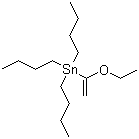 |
| Molecular Formula | C16H34OSn |
| Molecular Weight | 361.15 |
| CAS Registry Number | 97674-02-7 |
| EC Number | 641-308-0 |
| SMILES | CCCC[Sn](CCCC)(CCCC)C(=C)OCC |
| Density | 1.069 g/mL (Expl.) |
|---|---|
| Boiling point | 319.2 °C 760 mmHg (Calc.)*, 379.1 - 380.9 °C (Expl.) |
| Flash point | 160.3±28.4 °C (Calc.)*, 113 °C (Expl.) |
| Refraction index | 1.476 (Expl.) |
| * | Calculated using Advanced Chemistry Development (ACD/Labs) Software. |
| Hazard Symbols |     GHS06;GHS07;GHS08;GHS09 Danger Details GHS06;GHS07;GHS08;GHS09 Danger Details | ||||||||||||||||||||||||||||||||||||
|---|---|---|---|---|---|---|---|---|---|---|---|---|---|---|---|---|---|---|---|---|---|---|---|---|---|---|---|---|---|---|---|---|---|---|---|---|---|
| Risk Statements | H301-H312-H315-H319-H372-H400-H410 Details | ||||||||||||||||||||||||||||||||||||
| Safety Statements | P260-P264-P264+P265-P270-P273-P280-P301+P316-P302+P352-P305+P351+P338-P317-P319-P321-P330-P332+P317-P337+P317-P362+P364-P391-P405-P501 Details | ||||||||||||||||||||||||||||||||||||
| Hazard Classification | |||||||||||||||||||||||||||||||||||||
| |||||||||||||||||||||||||||||||||||||
| SDS | Available | ||||||||||||||||||||||||||||||||||||
 chemBlink Chemical Story
|
Tributyl(1-ethoxyvinyl)stannane, CAS 97674-02-7, is an organotin reagent used primarily in palladium-catalyzed cross-coupling reactions. Its molecular formula is C16H34OSn and its molecular weight is approximately 361.16. Structurally, the molecule contains three butyl groups attached to tin together with a 1-ethoxyvinyl group. Its most useful feature is not the tributylstannyl portion itself. The important cargo is the 1-ethoxyvinyl group. Under Stille cross-coupling conditions, this fragment can be transferred from tin to an aromatic or heteroaromatic carbon bearing a suitable leaving group such as bromine, iodine, or, under appropriately optimized catalytic conditions, chlorine. The result is an aryl or heteroaryl enol ether. That product can then undergo acidic hydrolysis. And something very useful happens: Ar-C(OEt)=CH2 becomes Ar-COCH3 In other words, the 1-ethoxyvinyl group becomes an acetyl group. This makes Tributyl(1-ethoxyvinyl)stannane a convenient synthetic equivalent for installing a methyl ketone at a position that originally carried a halogen. The strategy is especially valuable because direct introduction of an acetyl group onto a complicated heteroaromatic framework is not always straightforward. Instead, chemists can use the predictable carbon-carbon bond-forming behavior of a palladium-catalyzed Stille reaction. First transfer the masked carbonyl fragment. Then reveal the ketone. A published medicinal-chemistry example makes this sequence very clear. In work on potent and selective prostaglandin D2 receptor antagonists, a brominated heteroaromatic intermediate was subjected to Stille coupling with 1-ethoxyvinyltributyltin. Hydrolysis of the resulting enol ether converted the position originally bearing bromine into a methyl ketone. The transformation can be viewed simply as: Ar-Br → Ar-C(OEt)=CH2 → Ar-COCH3 The carbon-carbon bond is created in the first step. The carbonyl is revealed in the second. This two-stage logic is one of the reasons the reagent appears repeatedly in medicinal chemistry and total synthesis. A more recent patent example shows the same idea on a complex fused heterocycle. A brominated pyrroloquinazolinone was coupled with Tributyl(1-ethoxyvinyl)stannane using a palladium catalyst to give the corresponding 1-ethoxyvinyl intermediate. Treatment with hydrochloric acid then produced the acetyl derivative. The chemistry is remarkably modular. The aromatic or heteroaromatic framework can be highly complicated. As long as a suitable halogen or related coupling handle is present, the reagent can potentially deliver the same small two-carbon fragment. The tin portion plays a temporary role. During the catalytic cycle, the organic fragment attached to tin is transferred to palladium and then coupled to the electrophilic partner. The tributylstannyl portion does not belong in the final target molecule. This creates an interesting contrast inside the reagent. The 1-ethoxyvinyl fragment is there to become part of the product. The organotin portion is there to make the transfer possible. After coupling, the tin-containing residue must be separated from the desired material. This is also one of the practical disadvantages of Stille chemistry. Organotin compounds and tin-containing byproducts raise toxicity, waste-handling, and purification concerns. For this reason, synthetic chemists often prefer alternative coupling methods when they provide comparable results. Nevertheless, Stille coupling remains valuable in situations where its functional-group tolerance and reliable carbon-fragment transfer solve difficult synthetic problems. The 1-ethoxyvinyl version is particularly useful because it does something more subtle than simply install a vinyl group. It installs a vinyl ether that is deliberately temporary. The ethoxy group is not intended to survive. Acidic hydrolysis converts the enol ether into a ketone, transforming what initially looks like an alkene into a carbonyl-containing product. This is an example of functional-group masking. The chemist wants an acetyl group. But the fragment that behaves conveniently in the coupling reaction is not an acetyl group. It is a 1-ethoxyvinyl group. The molecule is therefore transferred in one chemical identity and revealed later in another. This strategy appears in many areas of synthesis. Published examples include kinase-inhibitor research, heteroaromatic medicinal chemistry, natural-product synthesis, and the construction of specialized photochemical protecting groups. In each case, the molecular surroundings may be different, but the logic remains recognizable: couple the 1-ethoxyvinyl fragment, then hydrolyze it to the methyl ketone. The chemistry also demonstrates why synthetic equivalents are so important. A synthetic equivalent is not necessarily structurally identical to the group ultimately desired. Instead, it is a reagent that behaves in a useful way during construction and can later be transformed into the required functionality. Tributyl(1-ethoxyvinyl)stannane is a particularly clear example. On paper, it is an organotin vinyl ether. In a synthetic plan, it can function as a hidden acetyl group. The reagent therefore tells a broader story about molecular construction. Sometimes the best way to install a functional group is not to install it directly. First install something that can survive the reaction you need. Then change its identity afterward. References 1. PubChem. Stannane, tributyl(1-ethoxyethenyl)-, CID 619414. CAS 97674-02-7. Molecular formula C16H34OSn; molecular weight 361.2. 2. Littke, A. F.; Schwarz, L.; Fu, G. C. (2002). "Pd/P(t-Bu)3: A Mild and General Catalyst for Stille Reactions of Aryl Chlorides and Aryl Bromides." Journal of the American Chemical Society, 124. 3. Sturino, C. F. et al. (2007). "Discovery of a Potent and Selective Prostaglandin D2 Receptor Antagonist." Journal of Medicinal Chemistry. Conversion of a brominated intermediate into a methyl ketone by Stille coupling with 1-ethoxyvinyltributyltin followed by hydrolysis. 4. US 11,059,784 B2. Oxime ether compounds. Conversion of aryl bromides to ketones through coupling with Tributyl(1-ethoxyvinyl)stannane followed by acidic hydrolysis. 5. Published medicinal-chemistry and natural-product syntheses employing 1-ethoxyvinyltributyltin as a masked acetyl-group equivalent. |
| Market Analysis Reports |