
Online Database of Chemicals from Around the World
| Taizhou Crene Biotechnology Co., Ltd. | China | |||
|---|---|---|---|---|
 | www.pharm-intermediates.com | |||
 | +86 (576) 8881-3233 8820-5808 +86 13396860566 | |||
 | +86 (576) 8822-9589 | |||
 | sales@pharm-intermediates.com | |||
 | QQ Chat | |||
| Chemical manufacturer since 2011 | ||||
| chemBlink Standard supplier since 2009 | ||||
| Shanghai Forever Synthesis Co.,Ltd. | China | |||
|---|---|---|---|---|
| www.foreversyn.com | |||
| +86 (551) 6288-8437 +86 18096409024 | |||
| sales@foreversyn.com sales02@foreversyn.com | |||
| QQ Chat | |||
 | Skype Chat | |||
| Chemical distributor since 2013 | ||||
| chemBlink Standard supplier since 2018 | ||||
| Shanghai Finetech pharm Co., Ltd. | China | |||
|---|---|---|---|---|
| www.finetechpharm.cn | |||
| +86 18221039705 | |||
| ad@finetechpharm.cn | |||
| Chemical manufacturer since 2016 | ||||
| chemBlink Standard supplier since 2026 | ||||
| Classification | API >> Inhibitor drug |
|---|---|
| Name | 15S-Travoprost |
| Synonyms | (5Z)-7-[(1S,2S,3S,5R)-3,5-Dihydroxy-2-[(1E,3S)-3-hydroxy-4-[3-(trifluoromethyl)phenoxy]-1-butenyl]cyclopentyl]-5-heptenoic acid 1-methylethyl ester |
| Molecular Structure | 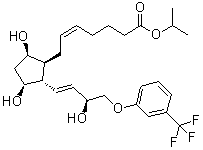 |
| Molecular Formula | C26H35F3O6 |
| Molecular Weight | 500.55 |
| CAS Registry Number | 340181-93-3 |
| SMILES | CC(C)OC(=O)CCC/C=C/CC1C(CC(C1/C=C/C(COC2=CC=CC(=C2)C(F)(F)F)O)O)O |
| Solubility | Insoluble (4.2E-3 g/L) (25 °C), Calc.* |
|---|---|
| Density | 1.245±0.06 g/cm3 (20 °C 760 Torr), Calc.* |
| * | Calculated using Advanced Chemistry Development (ACD/Labs) Software V11.02 (©1994-2014 ACD/Labs) |
 chemBlink Chemical Story
|
15S-Travoprost is a stereochemically defined analogue of travoprost, a synthetic prostaglandin F2α (PGF2α) derivative used in ophthalmology for the reduction of elevated intraocular pressure. Travoprost belongs to the class of prostanoid receptor agonists, which are structural analogues of endogenous prostaglandins designed to modulate aqueous humor dynamics in the eye. Prostaglandins are lipid-derived signaling molecules produced from arachidonic acid via the cyclooxygenase pathway. They play diverse roles in inflammation, vascular regulation, and smooth muscle activity. In the eye, prostaglandin analogues have been developed to enhance aqueous humor outflow, thereby lowering intraocular pressure in conditions such as glaucoma and ocular hypertension. Travoprost itself is administered as an isopropyl ester prodrug, which is rapidly hydrolyzed in ocular tissues to its active free acid form. The designation 15S-travoprost refers to a specific stereochemical configuration at the carbon-15 position of the prostaglandin backbone. Stereochemistry is critically important in prostaglandin biology, as prostanoid receptors are highly stereoselective and small changes in configuration can significantly alter receptor binding affinity and pharmacological activity. The active free acid form of travoprost binds to the prostanoid FP receptor, a G protein–coupled receptor located in ocular tissues such as the ciliary body. Activation of this receptor leads to remodeling of the extracellular matrix within the uveoscleral outflow pathway, increasing the drainage of aqueous humor from the anterior chamber of the eye. This enhanced outflow results in a sustained reduction in intraocular pressure. Prostaglandin analogues like travoprost are among the most effective first-line therapies for glaucoma. Their mechanism differs from agents that reduce aqueous humor production, as they primarily increase outflow rather than decrease formation. This complementary mechanism has made them central to modern glaucoma management strategies. The structural framework of travoprost is based on the prostaglandin F2α backbone, which contains a 20-carbon chain with multiple hydroxyl groups and a cyclopentane ring. The presence of multiple stereocenters in this structure gives rise to numerous possible stereoisomers, each with potentially different biological activity. The 15S configuration refers specifically to the orientation of the hydroxyl-bearing carbon at position 15, which is one of the stereocenters influencing receptor interaction. Travoprost is structurally modified from endogenous prostaglandins to improve metabolic stability and receptor selectivity. Fluorination and other modifications in related prostaglandin analogues contribute to enhanced potency and resistance to enzymatic degradation. These structural changes allow prolonged pharmacological activity following topical administration. From a pharmacological perspective, travoprost is highly lipophilic in its esterified prodrug form, enabling efficient corneal penetration after topical administration. Once hydrolyzed to the active acid form, it becomes more polar and engages the FP receptor to exert its biological effect. The balance between lipophilicity for absorption and polarity for receptor binding is a key feature of prostaglandin prodrug design. Stereochemical integrity is essential for the biological activity of prostaglandin analogues. The prostanoid receptors recognize specific three-dimensional arrangements of hydroxyl groups and side chains, and deviations in stereochemistry can reduce binding affinity or alter efficacy. Therefore, compounds such as 15S-travoprost highlight the importance of stereochemical control in drug design and synthesis. Overall, 15S-travoprost is a stereochemically defined prostaglandin F2α analogue that functions as an FP receptor agonist after conversion to its active acid form. Its significance lies in its role in lowering intraocular pressure by enhancing uveoscleral outflow, as well as in illustrating the critical role of stereochemistry in prostaglandin pharmacology and ophthalmic drug design. |
| Market Analysis Reports |