
Online Database of Chemicals from Around the World
| wuhan chemi Pharmacy Chemical Technology Co., Ltd. | China | |||
|---|---|---|---|---|
 | www.chemipharm.com.cn | |||
 | +86 13971619949 | |||
 | gmn424@chemipharm.com.cn | |||
 | QQ Chat | |||
 | WeChat: 13971619949 | |||
| Chemical manufacturer since 2014 | ||||
| chemBlink Standard supplier since 2026 | ||||
| Classification | Chemical reagent >> Organic reagent >> Thiol/thiophenol |
|---|---|
| Name | Pent-4-yne-1-thiol |
| Synonyms | 4-Pentyne-1-thiol |
| Molecular Structure | 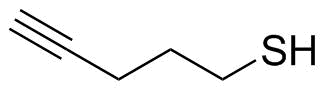 |
| Molecular Formula | C5H8S |
| Molecular Weight | 100.18 |
| CAS Registry Number | 77213-88-8 |
| SMILES | C#CCCCS |
| Density | 0.9±0.1 g/cm3 Calc.* |
|---|---|
| Boiling point | 137.1±23.0 °C 760 mmHg (Calc.)* |
| Flash point | 35.8±20.6 °C (Calc.)* |
| Index of refraction | 1.48 (Calc.)* |
| * | Calculated using Advanced Chemistry Development (ACD/Labs) Software. |
| Hazard Symbols |    GHS02;GHS05;GHS07 Danger Details GHS02;GHS05;GHS07 Danger Details |
|---|---|
| Risk Statements | H226-H315-H318-H335 Details |
| Safety Statements | P210-P233-P240-P241-P242-P243-P261-P264-P271-P280-P303+P361+P353-P304+P340+P312-P305+P351+P338+P310-P332+P313-P370+P378-P403+P233-P403+P235-P405-P501 Details |
| Transport Information | UN 1993 |
| SDS | Available |
 chemBlink Chemical Story
|
Pent-4-yne-1-thiol is a small sulfur-containing alkyne belonging to the class of aliphatic thiols with an internal carbon–carbon triple bond. Its structure consists of a five-carbon linear chain bearing a thiol group (–SH) at the terminal carbon (C1) and a triple bond between C4 and C5. This combination of a terminal thiol and an alkyne places it among bifunctional unsaturated organosulfur compounds, which are frequently used as reactive intermediates in organic synthesis. The chemistry of thiols has been studied extensively since the early development of organosulfur chemistry in the nineteenth and twentieth centuries. Thiols are sulfur analogues of alcohols, characterized by the presence of a sulfur–hydrogen bond that imparts distinctive chemical reactivity. Compared with alcohols, thiols are generally more nucleophilic and more easily oxidized due to the lower bond dissociation energy of the S–H bond and the higher polarizability of sulfur. Alkynes, on the other hand, have long been recognized as versatile functional groups in synthetic organic chemistry due to their ability to undergo addition reactions, cycloadditions, and metal-catalyzed transformations. The presence of both a thiol and an alkyne in the same molecule, as in pent-4-yne-1-thiol, enables dual reactivity, making such compounds valuable as building blocks in more complex synthetic strategies. The synthesis of alkyne-containing thiols is typically achieved through functional group interconversion of halogenated alkynes or protected sulfur precursors. A common synthetic approach involves nucleophilic substitution of a suitable leaving group at the terminal carbon by a sulfur nucleophile, often followed by deprotection steps if the thiol is initially protected as a disulfide or thioester. The formation of carbon–sulfur bonds is a well-established transformation in organosulfur chemistry and is central to the preparation of thiol-functionalized building blocks. The alkyne functionality in pent-4-yne-1-thiol introduces rigidity and unsaturation into the otherwise flexible aliphatic chain. This triple bond can participate in a variety of well-known organic reactions, including hydrogenation to alkanes or alkenes, hydration to carbonyl compounds under catalytic conditions, and cycloaddition reactions such as azide–alkyne cycloaddition, which is widely used in “click chemistry.” When combined with a thiol group, alkynes can also participate in thiol–yne addition reactions, which are important in polymer chemistry and materials science. Thiol groups are particularly reactive toward oxidation, readily forming disulfides under mild oxidative conditions. This property is biologically significant in amino acids such as cysteine, where disulfide bond formation plays a critical role in protein structure stabilization. In synthetic chemistry, controlled oxidation of thiols is often used to form disulfide-linked materials or to modulate reactivity during multi-step synthesis. From a physicochemical perspective, pent-4-yne-1-thiol is expected to be a relatively volatile and low-molecular-weight organic compound with limited polarity, aside from the polar thiol group. The presence of both a hydrophobic hydrocarbon chain and a polar sulfur-containing functional group gives it amphiphilic character on a small scale. Thiols also tend to have distinctive odors due to their volatility and strong interaction with olfactory receptors, a common feature of low-molecular-weight sulfur compounds. In synthetic applications, molecules like pent-4-yne-1-thiol are valuable intermediates for the construction of sulfur-containing polymers, surface modification agents, and heterofunctional linkers. The dual functionality allows selective reactions at either the thiol or alkyne site, enabling stepwise assembly of more complex molecular architectures. This makes such compounds useful in materials chemistry, particularly in the design of functionalized surfaces and responsive polymer networks. Overall, pent-4-yne-1-thiol is a bifunctional organosulfur compound combining a reactive thiol group with an internal alkyne. Its significance lies in its versatility as a synthetic building block, enabling diverse chemical transformations through thiol chemistry and alkyne reactivity, which are foundational tools in modern organic synthesis and materials development. References 2007. Photolysis of Pent-4-ynethiol. Science of Synthesis. URL: https://science-of-synthesis.thieme.com/app/text/?id=SD-246-00105 |
| Market Analysis Reports |